Ann Blyth will reach a milestone birthday this month - she will be 90 years old on August 16th. The Universal publicity photo above was taken just before Katie Did It (1951) when Ann was about 22 years old.
We'll celebrate her upcoming birthday the next few weeks with a few special posts.
Also, for the entire month of August, the eBook version of Ann Blyth: Actress. Singer. Star.will be reduced by 70% to $2.99. This special sale continues only this month, and only for the eBook version. This book grew from my year-long weekly posts on her career in the 2014 series I called The Year of Ann Blyth, starting with this one.
You can get your copy of the eBook here at these online retailers:
Joan Crawford’s Oscar award was the measure of her success. Arguably the pinnacle of her career, but in a career of so many makeovers and incarnations, so much achieved for the struggling young chorine with the Dickensian childhood and the lifelong need for recognition, with the strong on-screen personality and even stronger off screen, we may wonder not so much what an Oscar is worth, but what it was worth to her. It’s easy to assume she wanted it bad, but what was it worthto her?
Joan Crawford won Best Actress for her role in Mildred Pierce (1945), a movie which represented, yet again, another phase in her career as she had left, by mutual agreement, her over two-decade association with M-G-M, and attempted to rise from the ashes at Warner Bros. We covered Mildred Pierce here in our series on Ann Blyth, who, along with fellow castmate Eve Arden, were nominated in the Best Supporting category.Both lost to Anne Revere.
Joan Crawford was up against a tough field of other nominees herself: Ingrid Berman for The Bells of St. Mary’s, Greer Garson for The Valley of Decision, Jennifer Jones for Love Letters, and Gene Tierney for Leave Her to Heaven.
Reportedly, Joan feared that Ingrid Bergman was the shoe-in to win.I would have thought Gene Tierney was the more likely close contender with her powerful performance as the glamorous sociopath.Ingrid had won the statue only the year before, and Greer Garson and Jennifer Jones were former winners as well.
The 18th annual Academy Awards was presented on March 7, 1946. It was the first post-war awards, and the austerity that marked the ceremony during World War II was gone in a stream of klieg lights and the flash of camera bulbs popping.Plaster statues had been given out during the war—every metal except the fillings in your teeth was promised to The War Effort—and the post-war Oscars were bronze with gold plating.
Director Michael Curtiz had not wanted her for the role.Bette Davis had first dibs, and she turned it down.Curtiz preferred Barbara Stanwyck, who was interested, but he agreed to let Joan Crawford test for the role—as if she were an up and coming newbie—but was bowled over not only by her performance, but her willingness to work hard and humble herself to play a non-glamorous role, and worse still, the mother of a much more glamorous nearly grown daughter, played by Ann Blyth, who nearly stole the movie. Joan was generous to the newcomer and they became lifelong friends.
Bob Hope and James Stewart were co-hosts for the event, which was held at Grauman’s Chinese Theater.Radio station KECA broadcast the awards ceremony, with a nationwide hookup on the ABC radio network.ABC was only three years old, having been established in 1943 and formerly known as the NBC Blue Network.(The NBC Red Network became at that time simply NBC.) The radio program began at 9:30 p.m. Pacific Time.
Joan Crawford came to Hollywood with the name of Lucille LeSueur, and Pete Smith, head of publicity at M-G-M, saw great promise in the young actress, but not in her name, which he felt had to go.He set up a “Name the Star” contest in Movie Weekly magazine, and fans voted on the name.Joan reportedly was less than enthused about the final selection, but seemed to immediately grasp that she owed her career even more to the fans than to the moguls, and she courted them for the rest of her life.Her career, and her ultimate success, came through artifice, and she embraced it.
But she did not go to the ceremony.She listened to the Academy Awards on the radio that night on station KECA.So sure she would not win, and fearing losing in so public a setting, she spent the evening at home in her Brentwood mansion, in bed.She reported that she had a fever and pneumonia. She was 41 years old and undoubtedly wondered where her career was going next after this evening.
Joan Crawford's Oscar ceremony program
Charles Boyer presented the award for Best Actress.Joan Crawford sipped a few cocktails for courage.
He read Joan Crawford’s name.
We can only imagine her reaction.
Michael Curtiz accepted the award on her behalf.
Cue hairdresser and makeup artist, and off to Joan’s bedroom.
After the ceremony ended, Michael Curtiz went to her bedside to present the award, in the company of the press.Several other well-wishers, including young Ann Blyth, arrived at Joan’s house to congratulate her. It was considered to be an enormous comeback for a woman who had been regarded as a has-been only the year before.Her bed jacket and nightgown acceptance of the gold-plated prize was plastered all over newspapers, outshining any other victory of the evening.
In a woman notorious for hungering for legitimacy, did it give her the measure of self-worth she craved?
Years later, in a series of conversations in the 1960s and early ‘70s with interviewer Roy Newquist and published in his book Conversations with Joan Crawford, published in 1980, she presents a more complex, even sadder perspective on the event:
I remember how I felt the night the Awards were presented. Hopeful, scared, apprehensive, so afraid I wouldn't remember what I wanted to say, terrified at the thought of looking at those people, almost hoping I wouldn't get it, but wanting it so badly—no wonder I didn't go. I stayed home and fortified myself, probably a little too much, because when the announcement came, and then the press, and sort of a party, I didn't make much sense at all, even though I wanted to spill over...
I think the Academy voters honored me as much that night for A Woman's Face and Strange Cargo and maybe Grand Hotel as they did for Mildred. Or maybe it was for just staying around that long. Hollywood is like that; they compensate for their sins of omission later on, like the special awards they had to vote to Chaplin and Garbo in order not to seem completely ridiculous...
Winning the Oscar did revive her career, splendidly.She received two more Academy Award nominations, for Possessed (1947) and for Sudden Fear (1952).I assume she attended those awards, but I don’t know and I hope someone will fill us in.
And funny, the morning after, when I realized the award wasn't a dream after all, I realized that Mildred Pierce really rang down the curtain on "my" Hollywood. The character I played in that film was a composite of the roles I'd always played—and a few elements from my own personality and character. (Not the long-suffering bit; I'm too much of a Christian Scientist to suffer very long at a stretch.) My professional and personal worlds had changed so much—good friends were dying or moving away—the public was restless about making up its mind what it wanted to see—the studios were in bigger and bigger trouble. No, my day, my long and golden and often glorious day, had ended, and Mildred Pierce was sort of the bittersweet celebration of the end...
...In some respects everything that happened afterward—except Alfred [husband Alfred Steele]—was anti-climactic...It's like being a mountain climber: After you've done Everest, what's next? And, why?
Joan Crawford’s film career ended with Trog(1970) and she rang the curtain down herself, taking no further work, disillusioned with the film industry, with her own aging, and as the next few years passed, with ill health.She did not appear in public after 1974, and suffering from cancer, died in her New York apartment of a heart attack in May 1977.
Her friend, director George Cukor held a memorial service at the Academy of Motion Pictures Arts and Sciences.He said of her in his eulogy:
“She was the perfect image of the movie star, and, as such, largely the creation of her own indomitable will. She had, of course, very remarkable material to work with: a quick native intelligence, tremendous animal vitality, a lovely figure and, above all, her face, that extraordinary sculptural construction of lines and planes, finely chiseled like the mask of some classical divinity from fifth-century Greece. It caught the light superbly, so that you could photograph her from any angle, and the face moved beautifully....The nearer the camera, the more tender and yielding she became—her eyes glistening, her lips avid in ecstatic acceptance. The camera saw, I suspect, a side of her that no flesh-and-blood lover ever saw....I thought Joan Crawford would never die. Come to think of it, as long as celluloid holds together and the word Hollywood means anything to anyone, she never will.”
The Oscar she won was left to her daughter, Cathy Lalonde, along with all of her mother’s property, and shared an inheritance with her sister Cindy. She sold the Oscar at auction in 1993.It was only the third time an Oscar was offered at public auction, and it was the first major award to be sold in this manner.Expected to fetch between $8,000 and $12,000, the winning bid to a private collector was $68,000.
What is an Oscar worth?It depends on who you talk to.
Almost twenty years later, Joan’s Oscar was sold again at auction, in 2012. For $426,732.Does a gold-plated bronze statue appreciate in value?Or is it the reputation of the actress that has cachet?
That Oscar is 13.25 inches tall and weighs 6 pounds, 2 ounces.The plaque on the base is engraved:
“Academy First Award
To
Joan Crawford
For Her Performance In
'Mildred Pierce'”
It was described by Christie’s auction house to have, “Light speckling and rubbing to finish and scattered chips to base, else near fine.”In other words, it had flaws.But was still, like Crawford's body of work, “near fine.”
The souvenir program from that March 1946 ceremony at Grauman’s Chinese Theater was also auctioned off, and expected to fetch between $80 and $120.It sold for $875.
In 1970, right around Trog and before her self-imposed exile from the public view to the confines of her New York apartment, she participated in an interview with David Frost on his television show.With an expression that seemed to indicate she had re-lived that bedside Oscar win many times in her memory, she remarked as if still enthralled:
“I don’t think the public knows what the Oscar means to us.It is one of the most emotional things that can ever happen to a human being.”
Phantom of the Opera (1943) is a musical, a Technicolor feast for the eyes. There is a horror story in here, too, but it is cloaked in understanding and the eerie hindsight that dreams dashed can be a pervasive kind of horror.
Between the Phantom’s woes, portrayed with much more sensitivity than Lon Chaney’s infamous ghoul in the silent 1925 version, and the young soprano Susanna Foster’s real-life sorrows – there is enough pathos to make this movie a poignant ode to dreams that died.
The movie, more musical than monster, seems an homage to the world of operatic music than to the original nineteenth century penny-dreadful novel, though it was perhaps a smart move not to attempt to re-create the original classic silent story "note-for-note," as it were. We are given something extra, treated to the powerful baritone of Nelson Eddy and the beauty of Marta. Other “operatic” performances are not taken from operas, but are adapted works from Chopin and Tchaikovsky.
The Paris Opera of the late nineteenth century is the familiar setting for the tale, but there are differences in this movie – Nelson Eddy stars as the opera company’s baritone and Edgar Barrier plays Raoul, the local police inspector. Both men are romantic rivals for the hand of Susanna Foster, who plays Christine DuBois, a talented member of the opera chorus. The gents try to woo her, and Susanna enjoys their attention. Another man loves her and works to further her career – Claude Rains.
Mr. Rains is the Phantom of the piece – and there is no mystery about his identity. When we first meet him, he is not hiding in the shadows. He is in the orchestra pit playing the violin, a mild-mannered, middle-aged musician employee of the opera house. His encounters with Susanna are shy and awkward, and she gives him no thought other than he is a polite but odd old man. The Phantom is not a ghoul here, but a sad soul, and he breaks our hearts from the beginning. We discussed the original Phantom and the 2004 movie based on Andrew Lloyd Webber’s long-running stage musical in this previous post. We observed that the presentation of the Phantom had changed because of our evolution, not his:
Perhaps a good deal of this transformation of the Phantom in our popular culture has simply to do with ugliness. Gerard Butler’s Phantom is a man with what looks like a few old burn scars on part of one side of his face. Nothing we can’t live with, even though he vainly keeps it covered. Lon Chaney’s face is a rotting, putrid skull. It gives us nightmares. The original book was written in the days when ugly was synonymous with evil, at least as far as storytelling was concerned. Chaney’s film was made, similarly, when the representation of evil was done mainly through an image of ugliness. We still have film monsters who are ugly to be sure, but they are evil and ugly, not evil because they are ugly. There was not a whole lot of sensitivity towards people with mental or physical handicaps in those days, when desperate parents were still leaving deformed children with carnivals. There wouldn’t be any empathy left over either for folks who were less than beautiful. In the code of old Hollywood, the heroes and heroines were beautiful, and the sidekicks and villains were not.
Today we have a bit different take on evil, on beauty, and on empathizing with those who appear different, and that perhaps is one of the reasons why the Phantom has changed. He needs to be repackaged in order to be sold. It would be difficult to film the same 1925 story and present it to a 21st century audience, with the same simplistic judgments. The Phantom’s evil as represented today is more psychological, and more a problem of society because he has been treated so shamefully. Instead of nightmares, he gives us second thoughts.
Universal was known for monster movies as being its specialty, but it also produced a large number, even more than MGM, of what could be termed teen musicals. It is from their stable of talent they drew Susanna Foster and began to groom her as one of their biggest stars. As such, Susanna had a featured role in Bowery to Broadway (1944), which we discussed here, with another youngster who was to replace Susanna as Universal’s leading songstress – Ann Blyth.
The camera pans from Claude Rains playing violin with the orchestra in the pit, and pulls back to encompass a grand opera house interior, with every seat occupied by the well-to-do in their gowns, tuxedos, and jewels, in every box and loge. We finally pull back to the very end of the farthest rafters, the cheap seats, to reveal the enormous opulent glass chandelier. This, of course, has a prominent place in the story and the shot is breathtaking for its dual use as eye candy and premonition of things to come. It is more so a premonition because by 1943, though the original Phantom, while it may not have been as familiar to that generation, nevertheless had reached legend such that people knew the story they were about to see, or they thought they did.
There are flickering candles in every desk candelabra and overhead ceiling chandelier in every office, in every parlor and boudoir, casting shadows, and reflecting a warm glow. The film moves at a leisurely pace and we sink ourselves into its environment, from cold, gray streets, to actors adjusting costumes behind the flats backstage, to the grand but artificial sets on stage.
Claude rains plays Erique. He is a longtime employee of the opera house orchestra, but is fired because his playing has become slack, to which he attributes his hands and fingers becoming stiff. He may be one of the first people in classic films to be fired for a repetitive motion injury. But poor Erique has no workers’ compensation to fall back on. He is, worse still to any employer, getting old.
He is crushed by being dismissed, and wanders in a daze back to his one-room garret. We see he is living a poverty-stricken life, though his employer and others assume he must have a lot of money in savings from his 20-year career. However, we next see that he has spent his savings on a very expensive endeavor that is both a kindness and a fantasy. He has been anonymously paying for singing lessons for Susanna Foster, who does not know her benefactor. She has been studying with the Maestro – that’s our old friend Leo Carrillo, for three years.
Claude Rains also writes music, and he has an ace in the hole, a manuscript of a concerto he has been writing for years. He intends to have it published, thereby solving his money problem. However, the publishing house stalls him, treats him badly, and when he perceives that they are going to steal his work, in an angry rage he confronts the publisher, who is in conference with his lady friend. They are amusing themselves with his hobby of etching photos on steel plates with acid. Nothing says love in the afternoon like etching photos on steel plates with acid. Rains attacks the publisher and strangles him to death, and the lady friend grabs the acid and tosses it in Rains’ face.
Whimpering in pain, Rains staggers out of the office and through a maze of rain-washed streets. He is hunted by the police. He takes refuge, of course, in the city sewers that lead to the bowels of the opera house – and we have our Phantom.
He steals his trademark mask and cape from the opera house costume department. It is a rather stylish sea-green mask with eerily arched brows painted on it. He steals supplies from the opera house and lives there and continues to support Susanna Foster’s career, mainly by trying to oust the pompous Diva with threats of violence. Something in his gentle, befuddled personality has slipped askew – he is more cunning, more sinister, and will do anything to get what he wants – and now he wants Susanna, no longer content to love her from afar.
Claude Rains has become strangely athletic and acrobatic in his rope climbing and rafter leaping, and that rakish forelock that drapes over his mask adds a cavalier touch.
Look for Hume Cronyn as one of the police inspector’s men who chase the Phantom through the opera house and try to lay traps for him.
Susanna Foster, at the center of the piece, is a delicate figure, but despite being the focus of the film—even more than the Phantom in this version—she seems not to have a strong screen presence here, though perhaps the role of Christine is too passive to appreciate Foster's abilities as an actress. She was known for having the ability to reach the note B above high C in her vocal range; and the film presents her beautifully, exhibiting this tremendous gift. Perhaps this information was difficult for audiences who were not opera fans to appreciate, despite the Universal publicity department’s attempt to market it. Phantom of the Opera was her most important film, her fifth film. She began in Hollywood in 1939 at the age of 12 years old in The Victor Herbert Story, and her path went from MGM, which never used her, to Paramount; to Universal, where they had a robust youth unit whose most famous star at the time was Deanna Durbin.
Reportedly, Susanna was brought on to keep Durbin “in her place,” giving the studio the ability to threaten to replace Durbin with another soprano if she did not conform to their demands of her. Durbin turned down the Phantomscript and Susanna inherited the role. She only did a handful of films in her career. In 1945, Universal granted her wish to study opera and tour overseas, which she did, but then she decided to quit the movies.
She confessed to never being very ambitious and felt overwhelmed by the Hollywood machine, but she must really have been made of stronger stuff, for Susanna coped with more than her share of burdens. She grew up with alcoholic, abusive parents, but supported them and two younger sisters while she was still a child herself. When she returned from Europe and her movie contract was over, she reportedly gathered her resources, including selling her fur coat, to rescue and raise her two younger sisters and make a home for them. She eventually married baritone Wilbur Evans, but that union was unhappy. They did some stage work together, but when they divorced, though he was an absent father, he apparently demanded as part of the divorce decree that she not take their two sons more than 100 miles away from New York, thereby ending her attempts to have a comeback in film. She took work in New York City as a receptionist and did what she could with office jobs to support her two sons, with no help from her controlling ex-husband. Years later, she returned to the West Coast, and for a time, was homeless and living in her car.
According to author Bernard F. Dick in City of Dreams: The Making and Remaking of Universal Pictures (The University Press of Kentucky, 1997, p. 125), he notes that in 1989, Jane Withers and Margaret O’Brien learned that Susanna Foster was living in her car and “they came to her aid.”
Most poignantly, The Phantom of the Operahad begun an amazing new incarnation through Andrew Lloyd Webber’s blockbuster stage musical. At that time that Jane Withers and Margaret O’Brien were financially helping Susanna, Lloyd Webber’s Phantom was playing in Los Angeles. According to Mr. Dick, the two ladies “made it possible for her to see it.”
She had been the first singing Christine in a time when the Phantom began to appear less ghoulish to us and more troubled, more sad. For the first time, we saw his side of the story.
Susanna had a story, too. In her final years, her son (one had predeceased her) moved her back to the East Coast and was able to place her in nursing home care. She died in 2009 at the age of 84 at the Lillian Booth Actors Home in Englewood, New Jersey.
No horror story for the blog for this Halloween. At least, not the kind you were expecting.
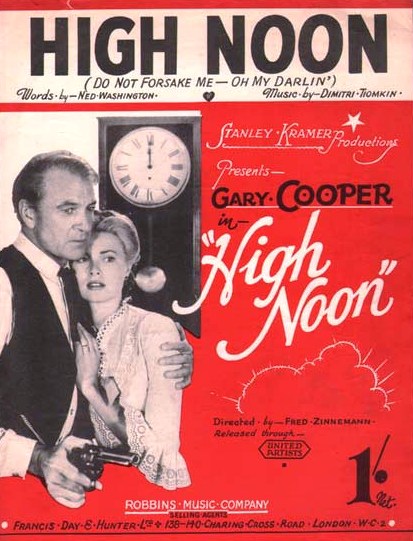
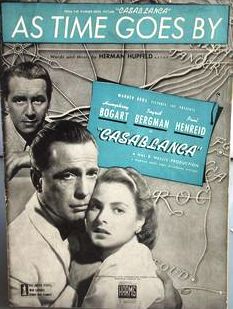
This week's post on my Ann Blyth: Actress. Singer. Star. blog features a contribution from an Ann Blyth fan -- scans of sheet music from her 1952 film The World in His Arms (which we had discussed in this earlier post) illustrating that the beautiful love theme I thought had no words actually was published with lyrics. Today we have a look at a few other examples of sheet music from classic films.
Hollywood was extremely resourceful in its juggernaut promotion of films, and sheet music played a role in publicizing a film by exploiting the popularity of songs from a movie, or by trying to make those songs popular to increase interest in the movie. The sheet music usually pictured stars on the cover, and that was an added feature desired by fans who collected photos of their favorites.
While these earlier decades of the twentieth century could boast a larger percentage of the population who owned pianos or otherwise played musical instruments, I suspect many collectors of these items kept them mainly for their walls and their scrapbooks.
Sheet music of movie themes continue to be published for modern films, but perhaps used today more in the form of a high school band playing the theme from Star Wars (1979). I don't imagine sheet music from modern films is as popular today among fans who are not musicians.
Do you have any sheet music in your classic film memorabilia collection?
Watch on the Rhine(1943) is a tale of resistance against fascism and the price of commitment. In its drawing-room intrigue on the showdown between Nazis, enablers of fascism, those who resist, and those who are completely naïve about the evil forces around them, it focuses on the motivations, regrets, and fears of a single resistance fighter.Paul Lukas, who won the Academy Award for his sensitive portrayal, is asked by Lucille Watson, his American mother-in-law, who gives his family refuge, about why he must always sacrifice for the cause against fascism?Why not leave the job to somebody else?
“But why must it always be your hands?”
He answers, “For each man, his own hands.He has to sleep with them.”
A day of reckoning comes to each person, for different reasons, and at different times.What we see today in American society commonly, and not so furtively called The Resistance is also a fight against fascism, but it is taking the form of a social movement, with brave public protests, and sometimes with casualties, but for everyone there is a price to pay.Watch on the Rhine has always been one of my favorite movies, and one of the aspects of the movie which I find so fascinating is the treatment of the Paul Lukas character.He is both a hero, and a fanatic, and yet he is a most mild-mannered gentleman, loving and kindly to his wife and children, rather beaten and weary in middle-age, and by his own admission, fearful.He is an unlikely hero, and his very gentleness and empathy, his being haunted over his resistance activities and what harm they do to his family makes him a very compelling character. But he has a backbone of steel and snaps into action like someone who never questions his own motives.
Ann Blyth performed with the original Broadway cast (not in the film), with Paul Lukas, George Coulouris, Lucille Watson, Frank L. Wilson, and Eric Roberts.In my book on Ann’s career, Ann Blyth: Actress. Singer. Star., I go into more detail on the stage play and its impact on American theatre – it was a tremendous hit.The eloquent script was by Lillian Hellman, and its director, Herman Shumlin, also directed the 1943 film.
We meet the resistance fighter in the very first moments of the movie. He does not look anything like a fighter of Nazis. He is a timid, shuffling family man, shepherding his wife and three children to the United States border with Mexico. They are coming to the United States as refugees from a war-torn Europe. They are nervous about going through customs. We see among the stack of passports stamped by the official that four are identical, and the top one is different from the others. That one is a United States passport because his wife, played by Bette Davis, is an American citizen. The first thing he says when they step over the line into the United States, “And now you are in your own land, Sara, and that is good.”
Just as the hero of the story does not look like a hero, the bad guys do not look like typical Hollywood Nazis. George Coulouris is a dapper Romanian ex-diplomat. We see him mostly in evening dress, and he is charming, well educated and well spoken. This movie shows us that the real evil are not the Nazis in uniforms, but the parasites among them who use those who are more powerful to get money, favoritism, and some of that power for themselves. Eventually, we get to see the local Nazi ringleader played by Kurt Katch, but he is not a smartly dressed in a commandant’s uniform. He is sloppily dressed in an old sweater playing poker. So far nobody looks as they should.
But he is really quite sinister because he is soulless and crafty. He sits in an office in the German Embassy in Washington, D.C. The Nazis are in the American homeland, close to the center of government. They are close to the bankers, the industrialists who support the regime. This Nazi shuffling cards is far more dangerous to our government than Panzer units.
We then see, in comparison, that George Coulouris is just a pawn. He is most certainly a danger to Paul Lukas, but he is fighting for his own rank and survival as well in a world of fascism. As we noted in our series of posts last summer (The Mortal Storm (1940),Address Unknown (1944),StormWarning (1951), Keeper of the Flame (1942),and Seven Days in May (1964)) that fascism is cannibalistic. Fascists always eat their own. We may see the correlation in our own time with the co-dependent, but adversarial relationship between Trump and Bannon, between Trump and Mitch McConnell, between Trump and every conservative Republican who needs him to put forth their agenda, but who will inevitably be stabbed in the back by him and possibly even share his fate if they do not shed their complacency.
The play, and the movie, is an examination of America’s innocence and naïveté not just about evil and our impending doom, i.e., entering the war, but the evil whirlwind that created it.
Complacency is the greatest evil in the movie. One of its representations is in the lovely Geraldine Fitzgerald, who plays George Coulouris’ wife, who hates him on principle but who puts up with him for much too long, until it’s almost too late. They sit in the garden as guests of Lucille Watson, themselves refugees from Europe, and Geraldine says, “I just lie still now and hope... Maybe something good will happen.”
There is the complacency of Lucille Watson and her son played by Donald Woods, who will have put Bette Davis and Paul Lukas in danger simply by having a sneak like George Coulouris in their home and giving him shelter; aid and comfort to the enemy, if you will, but also by not resisting. They have embraced American isolationism. They have not taken the moral step of resisting evil.
Paul Lukas resists evil at every turn, because he is practical and knows that fascism will devour his children and others if he does not fight it, and also because he is an idealist who believes that the world can be better. It is the fascinating picture of a sane fanatic, though he does worry, “Maybe now I am sick, too.” He has risked all to fight the Nazis, given up his engineering career, put his family in danger numerous times, they must always be on the run, and are often hungry. Is this the picture of a responsible husband and father, a protector and provider? He struggles with this dilemma.
There is, despite its sober message, a great deal of humor in this movie, and inspiration. But it is the discussion of one’s personal commitment to ideals that is most interesting to me. There is much food for thought in this movie.
The play and the screenplay are very neatly and intricately constructed. The cast are all splendid. The arrangement of the characters on screen to show their power struggles, their weaknesses in relationship to each other is excellent work by Director Shumlin, and it is quite interesting to see that though this is his first motion picture, he was as adept at understanding the perspective of the camera as he apparently was the power of stage blocking.
We can also incidentally note that Lucille Watson was a conservative Republican and Bette Davis was a liberal Democrat, but they could both contribute their talent to this noble Hollywood film that challenges American ideals and American commitment.
When Paul Lukas remarks to Lucille Watson that each man must decide for himself the level of his own commitment, “for each man his own hands. He has to sleep with them,” Donald woods replies, “I guess that’s how we should all feel. But you have a family. Isn’t there someone else who hasn’t a wife and children?”
Lukas replies, “Each could find his own excuse. Some have bullet holes. Some have fear of the camps, and many are getting old. Each could find a reason; many find it. My children are not the only children in the world, even to me.”
There were at least three radio versions of this play and movie of which I am aware. The first, which contains only scenes, is part of the 15 minute Treasury Star Parade promoting the selling of war bonds. The host is Fredric March. Paul Lukas and Mady Christians, who played the Bette Davis role on Broadway, play their characters and also have a brief interview with Fredric March. It was done during the road show of Watch on the Rhine in 1942 after it closed on Broadway and just before the motion picture was made.
Another version was made for Screen Guild Theater October 1, 1944 to promote the film. It stars Paul Lukas, Bette Davis, Lucille Watson, George Coulouris, and Donald woods, who all appeared in the movie.
Yet another version was made for Academy Award Theater August 7, 1946 again with Paul Lukas as the only member of either the original Broadway play or the movie to appear in this particular cast.
The play, when it was first produced in 1941 before we entered World War II, was a lightning rod for discussion on our susceptibility to fascism, not just homegrown Ku Klux Klan clowns and German-American Bund rallies, but also brought speculation on our possible insidious adoption of authoritarianism to which Europe seemed so susceptible. Would foreign agents be able to introduce that kind of corruption here, using our own isolationism, our apathy and disinterest for political intrigue against us? The banker, the industrialist, the press, sit like automatons around the poker table and watch the soulless Nazi deal them cards.
Lucille Watson and Donald Woods play host to a viper in their midst. Geraldine Fitzgerald stays with her husband, knowing he is evil, because standing up to him is too unpleasant. Then Paul Lukas, Bette Davis, and three kids straggle into the room after an exhausting journey of possibly 7,000 miles, thinking they are on a holiday in America, the safest place on earth. It would be difficult to pick out who in this cast of characters is the most gullible of all.One by one, each in his or her own way, become resistors. We don’t know the end of that story.
The play, incidentally, was produced again in Washington, D.C., this past February at the Arena Stage with Marsha Mason in the Bette Davis role.Read the review here by John Stoltenberg. The first paragraph indicates this story is still relevant:
Whatever this play meant to Broadway audiences when it debuted in 1941, just prior to America’s entry into a war of resistance to fascism abroad, what matters now is what it means to audiences just as America has entered a war of resistance to fascism here at home. Does Lillian Hellman’s principled script—now in a praiseworthy production on the waterfront at Arena Stage—stand the test of time? Does it warrant viewing, in other words, as a Watch on the Potomac?
Judging from audience response on opening night, the answer is yes. "Watch on the Potomac," indeed.