Tampilkan postingan dengan label blogathon. Tampilkan semua postingan

Minggu, 25 Februari 2018

Joan Crawford's Oscar for Mildred Pierce


Joan Crawford’s Oscar award was the measure of her success. Arguably the pinnacle of her career, but in a career of so many makeovers and incarnations, so much achieved for the struggling young chorine with the Dickensian childhood and the lifelong need for recognition, with the strong on-screen personality and even stronger off screen, we may wonder not so much what an Oscar is worth, but what it was worth to her. It’s easy to assume she wanted it bad, but what was it worthto her?


This is our entry in the 31 Days of Oscar Blogathon hosted by Aurora of Once Upon a Screen, Kellee from Outspoken & Freckled, and Paula from Paula’s Cinema Club.   

Joan Crawford won Best Actress for her role in Mildred Pierce (1945), a movie which represented, yet again, another phase in her career as she had left, by mutual agreement, her over two-decade association with M-G-M, and attempted to rise from the ashes at Warner Bros. We covered Mildred Pierce here in our series on Ann Blyth, who, along with fellow castmate Eve Arden, were nominated in the Best Supporting category.  Both lost to Anne Revere.

Joan Crawford was up against a tough field of other nominees herself: Ingrid Berman for The Bells of St. Mary’s, Greer Garson for The Valley of Decision, Jennifer Jones for Love Letters, and Gene Tierney for Leave Her to Heaven.

Reportedly, Joan feared that Ingrid Bergman was the shoe-in to win.  I would have thought Gene Tierney was the more likely close contender with her powerful performance as the glamorous sociopath.  Ingrid had won the statue only the year before, and Greer Garson and Jennifer Jones were former winners as well.

The 18th annual Academy Awards was presented on March 7, 1946. It was the first post-war awards, and the austerity that marked the ceremony during World War II was gone in a stream of klieg lights and the flash of camera bulbs popping.  Plaster statues had been given out during the war—every metal except the fillings in your teeth was promised to The War Effort—and the post-war Oscars were bronze with gold plating.


Director Michael Curtiz had not wanted her for the role.  Bette Davis had first dibs, and she turned it down.  Curtiz preferred Barbara Stanwyck, who was interested, but he agreed to let Joan Crawford test for the role—as if she were an up and coming newbie—but was bowled over not only by her performance, but her willingness to work hard and humble herself to play a non-glamorous role, and worse still, the mother of a much more glamorous nearly grown daughter, played by Ann Blyth, who nearly stole the movie. Joan was generous to the newcomer and they became lifelong friends.

Bob Hope and James Stewart were co-hosts for the event, which was held at Grauman’s Chinese Theater.  Radio station KECA broadcast the awards ceremony, with a nationwide hookup on the ABC radio network.  ABC was only three years old, having been established in 1943 and formerly known as the NBC Blue Network.  (The NBC Red Network became at that time simply NBC.) The radio program began at 9:30 p.m. Pacific Time.

Joan Crawford came to Hollywood with the name of Lucille LeSueur, and Pete Smith, head of publicity at M-G-M, saw great promise in the young actress, but not in her name, which he felt had to go.  He set up a “Name the Star” contest in Movie Weekly magazine, and fans voted on the name.  Joan reportedly was less than enthused about the final selection, but seemed to immediately grasp that she owed her career even more to the fans than to the moguls, and she courted them for the rest of her life.  Her career, and her ultimate success, came through artifice, and she embraced it.

But she did not go to the ceremony.  She listened to the Academy Awards on the radio that night on station KECA.  So sure she would not win, and fearing losing in so public a setting, she spent the evening at home in her Brentwood mansion, in bed.  She reported that she had a fever and pneumonia. She was 41 years old and undoubtedly wondered where her career was going next after this evening.

Joan Crawford's Oscar ceremony program

Charles Boyer presented the award for Best Actress.  Joan Crawford sipped a few cocktails for courage. 

He read Joan Crawford’s name.

We can only imagine her reaction. 

Michael Curtiz accepted the award on her behalf.

Cue hairdresser and makeup artist, and off to Joan’s bedroom.


After the ceremony ended, Michael Curtiz went to her bedside to present the award, in the company of the press.  Several other well-wishers, including young Ann Blyth, arrived at Joan’s house to congratulate her. It was considered to be an enormous comeback for a woman who had been regarded as a has-been only the year before.  Her bed jacket and nightgown acceptance of the gold-plated prize was plastered all over newspapers, outshining any other victory of the evening.

In a woman notorious for hungering for legitimacy, did it give her the measure of self-worth she craved?

Years later, in a series of conversations in the 1960s and early ‘70s with interviewer Roy Newquist and published in his book Conversations with Joan Crawford, published in 1980, she presents a more complex, even sadder perspective on the event:

I remember how I felt the night the Awards were presented. Hopeful, scared, apprehensive, so afraid I wouldn't remember what I wanted to say, terrified at the thought of looking at those people, almost hoping I wouldn't get it, but wanting it so badly—no wonder I didn't go. I stayed home and fortified myself, probably a little too much, because when the announcement came, and then the press, and sort of a party, I didn't make much sense at all, even though I wanted to spill over...

I think the Academy voters honored me as much that night for A Woman's Face and Strange Cargo and maybe Grand Hotel as they did for Mildred. Or maybe it was for just staying around that long. Hollywood is like that; they compensate for their sins of omission later on, like the special awards they had to vote to Chaplin and Garbo in order not to seem completely ridiculous...

Winning the Oscar did revive her career, splendidly.  She received two more Academy Award nominations, for Possessed (1947) and for Sudden Fear (1952).  I assume she attended those awards, but I don’t know and I hope someone will fill us in.

Again, on her Mildred Pierce win:

And funny, the morning after, when I realized the award wasn't a dream after all, I realized that Mildred Pierce really rang down the curtain on "my" Hollywood. The character I played in that film was a composite of the roles I'd always played—and a few elements from my own personality and character. (Not the long-suffering bit; I'm too much of a Christian Scientist to suffer very long at a stretch.) My professional and personal worlds had changed so much—good friends were dying or moving away—the public was restless about making up its mind what it wanted to see—the studios were in bigger and bigger trouble. No, my day, my long and golden and often glorious day, had ended, and Mildred Pierce was sort of the bittersweet celebration of the end...

...In some respects everything that happened afterward—except  Alfred [husband Alfred Steele]—was anti-climactic...It's like being a mountain climber: After you've done Everest, what's next? And, why?

She was not one to rest on her laurels, and even apparently did not mind lending her laurels to a friend.  Have a look here at my Ann Blyth: Actress. Singer. Star.  blog for the tale of how Ann borrowed Joan’s Oscar for a scavenger hunt.

The Oscar win joined pop culture with an episode of the TV show Saints and Sinners called "The Year Joan Crawford Won the Oscar" in 1963, which we discussed in this previous post. This may have been less a nod to her 1945 win than the buildup to the Oscar nominations in 1963 for Whatever Happened to Baby Jane?, discussed in this post on the TV miniseries Feud.

Joan Crawford’s film career ended with Trog(1970) and she rang the curtain down herself, taking no further work, disillusioned with the film industry, with her own aging, and as the next few years passed, with ill health.  She did not appear in public after 1974, and suffering from cancer, died in her New York apartment of a heart attack in May 1977.

Her friend, director George Cukor held a memorial service at the Academy of Motion Pictures Arts and Sciences.  He said of her in his eulogy:

 “She was the perfect image of the movie star, and, as such, largely the creation of her own indomitable will. She had, of course, very remarkable material to work with: a quick native intelligence, tremendous animal vitality, a lovely figure and, above all, her face, that extraordinary sculptural construction of lines and planes, finely chiseled like the mask of some classical divinity from fifth-century Greece. It caught the light superbly, so that you could photograph her from any angle, and the face moved beautifully....The nearer the camera, the more tender and yielding she became—her eyes glistening, her lips avid in ecstatic acceptance. The camera saw, I suspect, a side of her that no flesh-and-blood lover ever saw....I thought Joan Crawford would never die. Come to think of it, as long as celluloid holds together and the word Hollywood means anything to anyone, she never will.”

The Oscar she won was left to her daughter, Cathy Lalonde, along with all of her mother’s property, and shared an inheritance with her sister Cindy. She sold the Oscar at auction in 1993.  It was only the third time an Oscar was offered at public auction, and it was the first major award to be sold in this manner.  Expected to fetch between $8,000 and $12,000, the winning bid to a private collector was $68,000.

What is an Oscar worth?  It depends on who you talk to.

Almost twenty years later, Joan’s Oscar was sold again at auction, in 2012. For $426,732.  Does a gold-plated bronze statue appreciate in value?  Or is it the reputation of the actress that has cachet?

That Oscar is 13.25 inches tall and weighs 6 pounds, 2 ounces.  The plaque on the base is engraved:

“Academy First Award

To

Joan Crawford

For Her Performance In


'Mildred Pierce'”

It was described by Christie’s auction house to have, “Light speckling and rubbing to finish and scattered chips to base, else near fine.”  In other words, it had flaws.  But was still, like Crawford's body of work, “near fine.”

The souvenir program from that March 1946 ceremony at Grauman’s Chinese Theater was also auctioned off, and expected to fetch between $80 and $120.  It sold for $875.

In 1970, right around Trog and before her self-imposed exile from the public view to the confines of her New York apartment, she participated in an interview with David Frost on his television show.  With an expression that seemed to indicate she had re-lived that bedside Oscar win many times in her memory, she remarked as if still enthralled:

“I don’t think the public knows what the Oscar means to us.  It is one of the most emotional things that can ever happen to a human being.” 

Watch the David Frost interview below.


Please take a look at the other blogs in this terrific 31 Days of Oscar Blogathon hosted by Aurora of Once Upon a Screen, Kellee from Outspoken & Freckled, and Paula from Paula’s Cinema Club. 

Kamis, 02 November 2017

Preview of coming attractions...


Seventy years ago today - November 2, 1947 - the second of two half-hour radio programs aired called Hollywood Fights Back.  It was a cavalcade of some 50 stars challenging the House Un-American Activities Committee and its willful oppression of so many actors and actresses, writers, directors and producers.  Their participation in this event was nothing short of courageous -- and many of them would soon join the ranks of the unemployed for either being victims of the committee or for expressing sympathy for those that were.

Hollywood Fights Back is our topic for the upcoming Banned and Blacklisted blogathon hosted by CMBA - the Classic Movie Blog Association, and my post will appear in two weeks - Thursday, November 16th.

Another upcoming feature on this blog will be a series on women pilots in the heyday of air speed races and endurance challenges for daredevil pilots.  We'll have a look at Tail Spin (1939) with Alice Faye, Constance Bennett, and Jane Wyman; Women in the Wind (1939) with Kay Francis, William Gagnon, Victor Jory, and Eve Arden; Wings and the Woman (1942) on the exploits of real-life British pilot Amy Johnson; and finally, Flight for Freedom (1943) starring Rosalind Russell in a fictionalized account of Amelia Earhart.  


Selasa, 16 Mei 2017

Five Stars - National Classic Movie Day Blogathon


Today we join Rick at the Classic Film and TV Café blog for his Five Stars Blogathon to celebrate National Classic Movie Day.

The simple exercise is to name five classic film stars and why we like them; but that is not so simple.  I don't think I can narrow down my favorites to five, but the names I list here are certainly among my many favorites.

Teresa Wright, for her natural ability to project clear honesty and decency in her roles, not because they are role models, but because they are common variety people we feel we know, but whom her ability to elevate them to memorable and worthy characters is always astonishing and actually somewhat breathtaking.  Her work in the Fred's nightmare scene of The Best Years of Our Lives (1946) will always be an example of what Hollywood could do when it did its best.  Interestingly, the posed publicity photos of Teresa Wright all seem stilted and awkward, perhaps because she was not interested in stardom, but in acting.  Any frame of her
Shadow of a Doubt (1943) is far more lovely and intriguing than any posed photo I have seen of her.  Her staged photos could be used to sell soap; her Young Charlie is fascinating despite being the girl next door.


Ann Blyth, for reasons so numerous it took me a year of writing about her to express them.  I will simply summarize here by naming her versatility as my reason for including her on my list.  For elaboration, please see my Year of Ann Blyth posts beginning here, or have a look at my book Ann Blyth: Actress. Singer. Star. for the rest of it.  I think she's swell.

Joseph Cotten, whom we covered here in The Man with the Cloak (1951), is, probably like Teresa Wright, if not awkward then at least ordinary looking in his publicity photos.  Though he is handsome, there is not the same glamour of other male heartthrobs of the era, and so his film characters, like Wright's, do not jump out off the screen at us, but invite us and even captivate us with work that is not showy, and more low-key and honest.  The anxiety attacks of the soldier with PTSD in I'll Be Seeing You (1944), the struggling artist at the end of his rope in Portrait of Jennie (1948), the wolfish but sentimental family friend in Since You Went Away (1944), all turned around by the evil Uncle Charlie in Shadow of a Doubt (1943) -- these are fascinating examples of an actor who was a star, but whose repertory training never left him.  Repertory actors could be anybody.

Paul Lukas, whose work in Watch on the Rhine (1943), one of my favorite films, is notable for the delicate balance of heroism and fanaticism of the character.  Though Lukas, with his light Hungarian accent, played characters of European background and sensibilities, he almost appears like an American Abraham Lincoln/Gary Cooper/Davy Crockett in this movie, a straight, tall man of principle and stubborn fealty to honor -- yet a man who easily succumbs to violent measures to preserve it.  He is tortured by this, but carries it as both a sin and a duty.  I am surprised that Hollywood allowed him to reprise this stage role, since that was not their usual course, but I'm glad they did.  I really can't think of another popular actor of the day that could have played the role so brilliantly.

Wallace Ford, because he was always there, always reliable, and had the talent to be more than a supporting character player, but who raised the bar when it came to playing supporting character players.  From his youthful IRA gunman in The Informer (1935), to his Depression-era turns as the palooka husband/out of work boyfriend/store employee (as in Employees Entrance (1933), which I hope to get to later this year)/bank robber/detective (as in Crack-up - 1946) and in the previously mentioned Shadow of a Doubt/ex-safe cracker as in Dead Reckoning (1947), to his scruffy senior years of paunch and stubble face wily galoots, Wallace Ford is one of those names classic film fans cheer when they see the credits, and that's about as high an honor as it gets.  He starred on Broadway in Of Mice and Men, and that would have been something to see.  He had a remarkable personal life, which requires more space than I can devote to it here, but the hair-raising experiences of this Everyman were barely detectable in his cocky smile, his eyes that twinkled with humor, irony, and pain.

For more favorite stars of your favorite movie bloggers, head over to Rick's Classic Film and TV Café blog for his Five Stars Blogathon to celebrate National Classic Movie Day.

*********************
The audio book for Ann Blyth: Actress. Singer. Star. is now for sale on Audible.com, and on Amazon and iTunes.

Also in paperback and eBook from Amazon, CreateSpace, and my Etsy shop: LynchTwinsPublishing.


Kamis, 11 Mei 2017

New Robert Wise Book - - and 2 Blogathons!

Today a couple of announcements of coming attractions, and a note to draw your kind attention to a new book on the films of Robert Wise. 

The book is Robert Wise: The Motion Pictures by Joe Jordan, with foreword by Gavin MacLeod and introduction by Douglas E. Wise, nephew of the famed director.  I supplied a blurb for the author posted currently on Amazon:

“Meticulous research by Joe Jordan makes this a thorough study of director Robert Wise, which classic film fans will appreciate.  Jordan examines the body of Wise’s work in a film-by-film journey, his information woven neatly with interviews of participants providing the voices.  They are the soundtrack, and Jordan’s careful presentation of the material is the long tracking shot that lures us into a sudden, sharp, and breathtaking close-up, echoing the director’s own careful craftsmanship.”

If you're a fan of Robert Wise's work, have a look at this thorough survey of his movies.  It's available in eBook and paperback from Amazon.

**************


Also on the docket are two blog events for next week: First, National Classic Movie Day on Tuesday, May 16th .  A blogathon with many classic movie bloggers participating will be a treat for old movie fans.  Read more from Rick at Classic Film and TV Café for a list of blogs.  The topic is to pick our five favorite movie stars and why we like them.

*******************

Another blogathon to celebrate next week is the Classic Movie Blog Association (CMBA) Spring Blogathon, the topic for which is "Unseen and Underrated".  My pick for that post will be The Pied Piper (1942,) which will also lead off a series I'll be starting on the lives, and fate, of children during World War II as depicted in films of the era.

See you next week!

Kamis, 20 Oktober 2016

Cartoons Caricature Hollywood


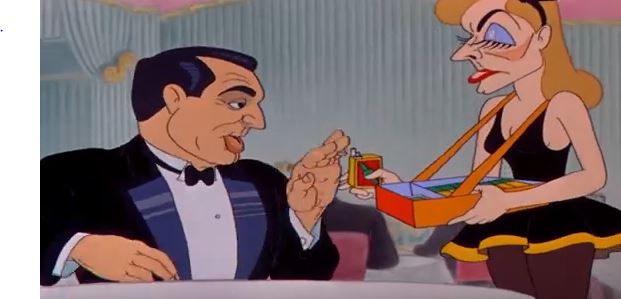
There are two aspects that immediately grab the viewer: first, the sometimes extreme ugliness of the caricatured images of stars who were otherwise celebrated for glamour; second, that these stars were marketed like products and brands of the studio based on their physical "type."  Nowhere is this more glaringly apparent than in their animated cartoon likenesses. 

Today we join the Classic Movie Blog Association's Hollywood on Hollywood blogathon.  Have a look here for more entries.


The cartoons we discuss today that lampooned the stars were produced by every studio.  One of the earliest, Mickey's Gala Primier (1933) was a black and white cartoon put out by Disney.  Mickey and Minnie Mouse attend a Hollywood premiere of one of Mickey's cartoons, and all the stars are there, emerging from a single limousine, as klieg lights arch into the sky.  Wallace Beery and Marie Dressler, the three Barrymores in their Rasputin guises (a movie we covered here), Laurel and Hardy, the Marx Brothers, Eddie Cantor, Jimmy Durante, Joan Crawford--a huge list of greats. Some like George Arliss would not be as identifiable possibly even ten years later, that is to say he would not have been worthy of parody in popular culture.  Greta Garbo, however, who was much parodied in these cartoons (in particularly unflattering jibes), was a star whose greatness can be measured by the fact that her name was still identifiable long after she stopped making films, and was therefore still the butt of jokes.

The Hollywood Bowl (1938) was put out by Universal under Walter Lantz, known for Woody Woodpecker, which, again in black and white, showed all the major stars of the day attending a performance at the Hollywood Bowl.  Bing Crosby, W.C. Fields are among the most well-known here--and Garbo is again skewered, invariably portrayed as a somewhat somnolent stooge--but Jean Hersholt is on hand, and the Ritz Brothers, all probably less identifiable to later audiences.

Ned Sparks seems to pop up with great regularity in these cartoons too.  For film buffs, trying to name the actors flashing on screen for only seconds at a time is great fun and quite challenging.

Katharine Hepburn's angular features and distinctive voice always make her a good target for caricaturists and she appears in this cartoon, as well as others in the 1940s.  Joe E. Brown, the enormous mouth that devours the entire screen is another regular, but in this cartoon, Benny Goodman, Cab Calloway, Rudy Vallee, and Leopold Stokowski, his  long hair in a snood, also get the works.  What may be surprising to young fans of classic films and cartoons today was that conductor Stokowski was actually something of a "rock star" in his day. 


He also appears in Hollywood Steps Out (1941), which, as you can see by the screen caps here, has some of the best drawn, and least offensive, caricatures of the stars.

Included in this one are Ann Sheridan, Sonja Henie on skates, Cesar Romero, Mickey and Judy, Henry Fonda, but I'd have to say my favorite is of C. Aubrey Smith. 


The Golden State (1948) is a travelogue type cartoon (that ends in a singalong of "California Here I Come") with cameos of Dorothy Lamour, who is of course, in a sarong, as well as Johnny Weismuller in Tarzan garb. 

Hollywood Picnic (1937) gives us, along with Garbo and Joe E. Brown, without whom no cartoon lampoon of the stars is complete, a brief glimpse at Edward Arnold, which seems surprisingly without any exaggeration, and a stereotyped Stepin Fetchit.  Young audiences today will justly be offended at the racism, however they will likely be ignorant that this portrayal of Fetchit was on the mark: this was his act.  This was his brand.  Joe E. Lewis had a great career on Broadway, but in Hollywood, his brand was his large mouth.  James Stewart was a terrific stage and screen actor: to Hollywood, he was a lanky, stammering twit.

Edna May Oliver, likewise, an esteemed stage actress whose screen roles were exquisitely nuanced, had her value to Hollywood, especially the publicity departments that pushed these cartoons, reduced to an ugly old lady.

Hollywood Detour (1942) brings the gang back for a bus tour of the town.  This one was Columbia.  Garbo is back with her large feet and sleepy affect.  Fred Astaire and Rita Hayworth, however, get off without being cruelty teased.

Mother Goose Goes Hollywood (1938), another Walt Disney offering, gives comic sendups of Hepburn, Spencer Tracy and Freddie Bartholomew, Edward G. Robinson, Martha Raye, and most of the others mentioned above.

There seemed to be less cartoon parodies of the stars by the mid 1940s--though Humphrey Bogart and Lauren Bacall would pop up in Slick Hare (1947) and in Eight Ball Bunny (1950).  Here the caricatures are not unkind.


When the studio system began to break up and the actors were free agents, they were less likely to be marketed according to their branded caricature. 

Did audiences of the day discover through these cartoons what brilliantly blue eyes William Powell had, an actor they normally saw only in black and white films?

Take a look at the other swell blogs participating in the Hollywood on Hollywood blogathon.
****************

The audio book for Ann Blyth: Actress. Singer. Star. is now for sale on Audible.com, and on Amazon and iTunes.


Also in paperback and eBook from Amazon.


Kamis, 13 Oktober 2016

News of Current Events...

Just a brief update today on some current events:

First, for those who prefer to buy their books in bookstores and not online, a new independently owned bookstore has opened in Westfield, Massachusetts, in the heart of the historic district right on the town's beautiful common.  It's called Blue Umbrella Books, and they now carry all my books.  In fact, I'll be doing an author signing with them in December -- more on that later. 

So for those of you in western Massachusetts and northern Connecticut -- or any of you folks across the country who'll be up in New England this month doing your leaf peeping (what we call being on fall foliage tours or driving out to look at the leaves) -- stop in to Blue Umbrella Books and say hi.  (Westfield has some mighty nice other stores too.)

***************


Next week, I'll be participating in the Classic Film Bloggers Association annual fall blogathon -- this year the subject is "Hollywood on Hollywood."  My post will be up next Thursday the 20, and I'll be covering how some classic cartoon caricatured the Hollywood stars. Have a look here at the CMBA website for a roster and links of terrific blogs and their topics for this blogathon.

See you next week.

Kamis, 14 April 2016

Letters in Old Movies


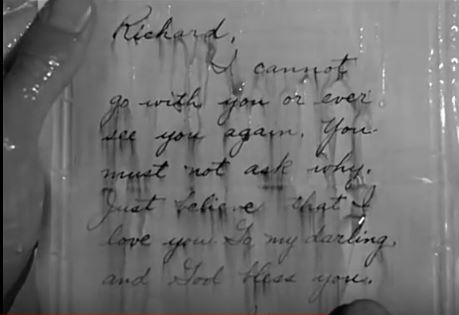
Humphrey Bogart stands on the train platform in the rain, reading the letter Ingrid Bergman has written to him.  The next few frames of the movie are focused on the letter, its handwriting melting to a blur as the ink bleeds down the page from the rain.

Some classic films, such as The Letter (1940) and Love Letters (1945) discussed here, and The Shop Around the Corner (1940) discussed here, have plots that are predicated on a letter.  A letter is the catalyst for conflict in the story.  There are a lot of movie plots we could add to this category, like A Letter to Three Wives (1949).  A letter is the incriminating evidence, or provokes a mystery, or a love letter may bring the wrong lovers together, or incite jealousy. 

But the use of letters, moreover, showing the handwriting on the letter is such a typical device used in old movies that we might regard it a cliché, though I don’t think I’ve ever seen it parodied.  It certainly could be, but perhaps the image of handwritten letters is so natural to this era that we accept it without thinking.  In this previous post, readers responded with what were their favorite images commonly seen in old movies: the passage of time with flipping calendar pages, or the candle stick desk phones, men’s broad-brimmed hats, etc.  We can also see all of these in modern movies set in the 1930s or 1940s, and we can see them in parody skits, but I don’t think the use of a handwritten letter has been used in decades since the era when handwritten letter were the major form of communication, in business and in personal use.

I especially love moments in old movies where a letter has nothing to do with the plot, but it’s there as a convenience.  Consider White Christmas (1954), where Anne Whitfield passes a letter written by Rosemary Clooney to her sister, Vera-Ellen.  The letter informs Vera-Ellen that Rosemary, not wanting to stand in the way of what she thinks is her sister’s impending marriage, breaks up their stage act and has taken a job in New York.  Vera-Ellen merely glances at the letter to know all the contents, and passes it to Danny Kaye, who, likewise, merely glances at the letter to know all its contents.  They may be speed readers, but the director gives us a few frames of the actual letter to read because we don’t read as fast.

We are included in the letter reading.  It is as if Vera-Ellen has passed the letter around to us too.  The audience shares the news “real-time.”  We are reading over her shoulder.

Who really wrote the letters in the movies?  Was it a staff of talented handwriting stand-ins?  A studio secretary with a high school prize for penmanship?  I’d love to know.  A reader commented once that the handwriting in two different letters in two different movies looked the same.

I suppose the most famous letter in literature is the very long and detailed letter Mr. Darcy wrote to Elizabeth Bennett in Pride and Prejudice, explaining the back story of his relationship with Mr. Wickham and the treachery done to his sister, and why Darcy interfered with Mr. Bingley’s relationship with Elizabeth’s sister Jane.  It’s a bomb dropped in the middle of the story, and turns the whole plot on its head. 

He may be a closemouthed fellow when it comes to talking, but in a letter, Darcy goes on forever, yadda, yadda, yadda.  We would not likely see such a long letter printed verbatim in a modern novel. Even modern film adaptations of Darcy’s famous letter tend to abbreviate his epistle, or illustrate its points instead in dramatic flashback scenes.  The directors must think modern audiences will not sit still for a little juicy letter reading.

In many schools today, cursive handwriting is no longer taught.  Many of us have youngsters in our families who cannot write or read cursive handwriting.  This is unfortunate on many levels, most especially that they will not be able to read historic documents, including the personal letters preserved in their own families.

But it also means they will not be able to read Rosemary Clooney’s letter to Vera Ellen, or Ingrid Berman’s letter to Bogie, or any of the notes and handwritten clues as to why the actors are behaving the way they do—remember, their actions are not always explained.  Reading the letter saves us from having to say what has happened off screen.

“Why is Bogie sad, Mommy?”  Now, doesn't that just tear your heart out? 

The letter writing and letter reading scenes are passive, yet still powerfully dramatic.  The letters convey intimate news.  Sometimes they are kissed or embraced because they represent the person that wrote them.  Sometimes they are stashed quickly in a hiding place.  Sometimes they are burned, or crumpled and thrown away. 

This is what Bogie does when the goodbye letter that kicks his guts out has become illegible from the rain, substituting for tears, as Ingrid’s words bleed down the page.  He stands on the steps of the now moving train, crushes the soggy paper in his fist, and tosses it to the tracks.

Deleting an email, or "un-friending" someone was never so dramatic, or so satisfying.

What are some other favorite “letter scenes” of yours?

Please have a look at the other great posts in the Words, Words, Words blogathon.


****************************


"Lynch’s book is organized and well-written – and has plenty of amusing observations – but when it comes to describing Blyth’s movies, Lynch’s writing sparkles." - Ruth Kerr, Silver Screenings


"Jacqueline T. Lynch creates a poignant and thoroughly-researched mosaic of memories of a fine, upstanding human being who also happens to be a legendary entertainer." - Deborah Thomas, Java's Journey

"One of the great strengths of Ann Blyth: Actress. Singer. Star. is that Lynch not only gives an excellent overview of Blyth's career -- she offers detailed analyses of each of Blyth's roles -- but she puts them in the context of the larger issues of the day."- Amanda Garrett, Old Hollywood Films

"Jacqueline's book will hopefully cause many more people to take a look at this multitalented woman whose career encompassed just about every possible aspect of 20th Century entertainment." - Laura Grieve, Laura's Miscellaneous Musings

"Jacqueline T. Lynch’s Ann Blyth: Actress. Singer. Star. is an extremely well researched undertaking that is a must for all Blyth fans." - Annette Bochenek, Hometowns to Hollywood


Ann Blyth: Actress. Singer. Star.
 
by Jacqueline T. Lynch

The first book on the career of actress Ann Blyth. Multitalented and remarkably versatile, Blyth began on radio as a child, appeared on Broadway at the age of twelve in Lillian Hellman's Watch on the Rhine, and enjoyed a long and diverse career in films, theatre, television, and concerts. A sensitive dramatic actress, the youngest at the time to be nominated for her role in Mildred Pierce (1945), she also displayed a gift for comedy, and was especially endeared to fans for her expressive and exquisite lyric soprano, which was showcased in many film and stage musicals. Still a popular guest at film festivals, lovely Ms. Blyth remains a treasure of the Hollywood's golden age.


The eBook and paperback are available from Amazon and CreateSpace, which is the printer.  You can also order it from my Etsy shop. It is also available at the Broadside Bookshop, 247 Main Street, Northampton, Massachusetts.

If you wish a signed copy, then email me at JacquelineTLynch@gmail.com and I'll get back to you with the details.

**************************
My new syndicated column SILVER SCREEN, GOLDEN YEARS, on classic film is up at Go60  or check with your local paper.