Tampilkan postingan dengan label Bette Davis. Tampilkan semua postingan

Kamis, 19 April 2018

Phone Call from a Stranger (1952)


Phone Call from a Stranger (1952) is engrossing for the work of its cast, the sensitive and shrewd viewpoint of the director, and mostly for being a fine example of what was most entertaining about classic films:  They were almost always character studies, and the characters were not so very different from us. Also, they were quite bold and courageous about playing the ball where it lies.

When a child reads Cinderella, there is no questioning the logic of how there could be such a thing as a glass slipper and that there’s only one person in the whole kingdom whom it will fit. That's just the way it is.  The child accepts those terms in order to enjoy the story.


In Phone Call from a Stranger, we are expected to accept a series of unusual or even unlikely scenarios as a matter of course. Therein do we find the magic of storytelling.

Many critics and fans alike will point to classic films as examples of entertainment that were escapist. For many films, this was true, but even in the most fantastical adventure what I find most compelling in classic films is not their escapism but their relevance.  Time and again, I find relevance more than escape.

What I also admire about the people who made classic films is that they had the guts to focus on the most mundane lives and circumstances to launch an adventure. In many respects we've gotten away from that in our modern films and television entertainment, where to be competitive in the marketplace where there is so much competition, the film's story must have some sort of special hook to it, either the characters must be unusual or their experiences must be, or they must be seen as representing a segment of society which is currently marketable.

But old movies, in an era where they churned them out by the dozens by the week, there was little self-conscious need to market the story right from the script.  That was the purview of the publicity men; directors and writers and actors could be more playful with an idea. It didn’t always necessarily need to be considered logical.

Phone Call from a Stranger is a mystery, a character study, a moralistic fable, that is also quite funny at times, and often unflinching at the foibles and inconsistencies of not only its characters but of us.  It also manages to be inspirational.

Gary Merrill stars as a lawyer who is leaving his wife because she has been unfaithful to him. Like a noir film there are flashbacks and it will take almost until the very end of the film until we understand his whole story and his motivations. At first, we only know that he is angry and resentful, that he loves his wife and two daughters, but he cannot reconcile himself to living with her anymore. He leaves his Midwest home to take a flight to California to start a new life.

The film begins as a noir, at midnight, in a rainstorm, with ominous music flooding over the title and credits.

By the way, there’s going to be enough spoilers in here to choke a horse.  You love spoilers?  Oh, that's fine, then.

He takes a cab to the airport and books his one-way flight by an assumed name so that she cannot track him down, yet he calls her from a phone booth so that she will not worry. We see from the very first moment of the film that despite his need to escape his life, which has become bitter and disappointing, he still has enough sympathy for his wife not to put her through the agony of wondering where he went. He tells her he will be in touch. The rain drips off the brim of his fedora.

He will spend the next couple of days on a long-distance journey full of layovers and delays in the company of three other passengers. They are Michael Rennie, a doctor; Keenan Wynn, a traveling salesman; and Shelley Winters, a second-rate actress. Director Jean Negulesco allows their stories to unfold in a leisurely way that is interesting and easily keeps the audience's attention with a kind of sleight-of-hand that is as effective as Hitchcock's but much more subtle. There are mysteries all around us, and sudden tragic scenes of violence, but it is the deceptively normal, innocent moments of seeming irrelevance that keep us off balance the most.

Michael Rennie, who we last saw in I'll Never Forget You (1951) here, plays a reserved, gentlemanly, and somewhat anxious man. Like Merrill, he seems to have some secret trouble.
Keenan Wynn is a joker and a constant motormouth, pulling out novelty items like clattering teeth and funny glasses and letting rip off high, maniacal laugh that echoes in the lunch room, in a waiting room, on the plane. He is a little annoying for his over-the-top extroverted character. We haven't an inkling what his story really is, not because he is more clever at hiding his emotions than the other three, but because he is less burdened by them, and that will be the most amazing thing of all.

Shelley Winters, who played goodhearted but common-as-dirt dames, is very likable as a small-time performer who wants to be a big-time actress but has failed to gain any traction in New York. She is flying home to California to rejoin her husband and his overbearing mother because she misses him and she has learned that the bright lights of Broadway are probably not going to shine on her. Rather than being despondent about that, she has decided to focus herself on her marriage, what she realizes means more to her. Because she is so gregarious, she draws out the back stories of the three men. She guesses before anyone, with common sense and razor-sharp astuteness, that Rennie is a doctor and that Keenan Wynn is a traveling salesman, and she has guessed that all the men are married. She freely discusses her own problems and we can commiserate with her about her fear of flying on her very first plane trip.

It's fun to see the trappings of the era: walking out to the plane on the tarmac; the plane, a prop job with a small cabin; the smoking and no smoking and fasten seatbelt lights going on and off in the days before jets when a transcontinental flight would actually have to make stops to refuel at certain points along the way. It is on the stops that they get to know each other.

Gary Merrill, despite his troubles at home, has the easiest manner of the bunch, is the most level-headed and patient with them. He is a lawyer.  It is his calm nature that makes Shelley Winters want to sit next to him on the plane. At one point, in their chumminess, when he puts his seat back to sleep, she does the same and jokes about their spending the night together. For those who find it difficult to sleep on planes, one has to envy them in the shot at night when most of the people on the plane are asleep even during a violent thunderstorm. When the storm forces them to land in an out of the way spot, they sing “The Man on the Flying Trapeze” as the plane lurches in the descent.  (Quick, what other road movie has the characters singing “The Man on the Flying Trapeze?”   Yeah, I know you know.  It Happened One Night -1932, which we discussed here.)  In a panic, Shelley Winters clutches Merrill’s hand, and lurches forward with what looks like a stomach-churning lift of the plane.

Gary Merrill, with that craggy face had a wonderful knack for playing unassuming characters of quiet strength that were somehow heroic simply for being unassuming. During one point in the trip, the plane has come to a difficult landing and in a layover waiting for the storm to pass he and Michael Rennie discuss Rennie’s troubles. He wants Merrill's help and his professional judgment as an attorney.
Five years earlier, when at a dinner dance at a country club, Rennie had too much to drink and was called away to perform surgery on a patient. His fellow physician, played by our friend Hugh “Ward Cleaver” Beaumont went with him. In a childish bit of drunken bravado, in spite Beaumont's protests and perhaps because of them, Rennie drove very recklessly and they got into an accident. Beaumont was killed, as were two others in a car with which they collided. Rennie lied to the police, telling them Beaumont was driving, and his wife, played by Beatrice Straight, stoically and with disgust, did not contradict her husband, lying as well to protect him. Their son never knew the truth, but he did observe the break in his parents’ marriage after this incident where his father drank more and his mother seemed to shut him out. This is told in flashback scene.


Now Rennie is coming home to California to face the music and he wants Gary Merrill to go with him to the DA’s office to tell them the truth. He had already gotten away with it, but he can no longer live with his guilt and needs to regain his wife's respect. Rennie is brittle, bitter, good with the conflict.

Shelley Winters is charming in her effortless and natural friendly if outspoken dame who’s been around the block, not playing it at all like a stereotype.  There is something sweet and childlike about her.  She confesses to Merrill about her failure to hit it big in New York and her desire to go home to be with her husband.
Her biggest problem was the conflict she had with her mother-in-law, an ex-vaudevillian, played with venomous panache by Evelyn Warden, who owns a supper club in Los Angeles where her son, Shelley's husband, performs with her. Mama rules the roost, and she disliked Shelley from the beginning. But Shelley is willing to go home and even brave her mother-in-law just to be with her husband again. She’s a people person, and it’s fun to watch her figure out what makes everyone tick.  We realize, later on, that she has given Merrill a lot to think about.

Keenan Wynn seems such a shallow and trite man that we don't imagine there is anything below the surface, and others refer to him, among other things, as a jerk.  We never get a chance to get his story – the plane crashes.

It happens on the second leg of the journey, the next morning, when the day is fine and there is no hint of the noirishness of the night before. It is shocking when, in an instant, the pilots notice ice on the wings, and Shelley Winters’ body is thrown over Gary Merrill, on top of us, and the whole plane lurches, and then we see the plane flailing through the trees and upending. We see the inevitable headlines about the plane crash – most of the people on board are dead, except for three who survive.

We wonder which three of the four lived?

We’re next brought to a hotel room in Los Angeles and – Gary Merrill walks through the door.   

He has facial bruises, his arm in a sling, his torn suit a mess and we see he has just gotten out of the hospital. He dictates a telegram to his wife telling her where he's going to be staying for a few days but mentioning nothing about the plane crash. She would not have been alerted to it, because he had checked in under a phony name anyway. He could have gotten away with disappearing.

Absentmindedly, he reaches into his pocket and pulls out the business cards of the two men and a piece of paper with Shelley's address info on it. The four musketeers, as they called themselves, decided that they would keep in touch.

We realize now that the other three have all been killed.

Merrill seems to be making up his mind about something, and his character suddenly takes the movie one step further, one step beyond a typical plane crash movie. What happens next isn’t about the crash, but about the families of these three characters and what happens next for them. 

Merrill does the very noble thing of contacting their loved ones, not only to bring them comfort to share with them the last moments, but to right some wrongs and to repair the damage in the lives of the deceased so that at least the living can go on.

In the case of Michael Rennie, Merrill visits his wife who laments that their teenage son has run away.  He does not know the truth about his father. Gary Merrill tracks him down, brings him home and tells the boy, played by Ted Donaldson (whom we saw here in A Tree Grows in Brooklyn – 1945) the truth about his father's guilt in the accident and reminds him that an indecent man would've taken pleasure to have gotten away with something; a decent man is horrified by the guilt. He also learns that his mother has protected him. The son grows up quite a bit in those few minutes. The family is restored even though Rennie will never come home to them, and his memory will be sweeter for them. In a sense, he has come home.


Next Merrill tackles Shelley Winters’ story. He goes to the supper club where her mother-in-law is onstage, the next to the last of the big hot mamas, and a cute, if well-worn, club routine with her son, who is played by Craig Stevens. It's not a large role but Craig Stevens always acquits himself very well and it is a pleasure to see him in anything. He jokes on stage with mom and gets to sing a song, although I'm not sure that's really his voice on “Again”, though he was a singer and clearly sings the preceding “The Old Gray Mare.”
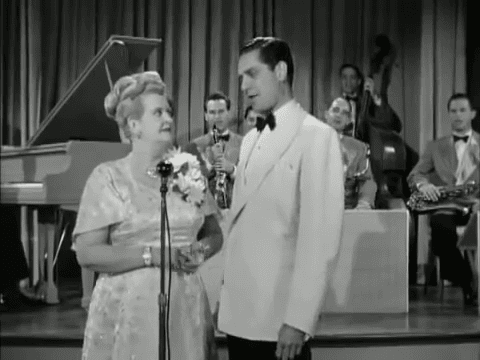


Merrill gets to see just how overbearing mom really is. She is rude, selfish and bad-mouths Shelley Winters and has tried to break up the marriage, wanting to keep sonny boy to herself. She tells her side of the story in a wholly made-up flashback that seems to parody noir movie flashbacks, but Merrill sets the path straight by throwing in a cute flashback of his own imagining where Shelley Winters has been a big hit on Broadway taking over for Mary Martin in South Pacific. It’s a clever and really funny bit where we see Shelley pantomiming the stage bits of Nellie Forbush including washing that man out of her hair, and he tells her that Shelley wanted to have her mother-in-law join the cast as Bloody Mary, had she not been killed in the plane crash. Mother-in-law, who would have killed for the part, is finally put in her place and her big mouth is finally shut once and for all. Craig Stevens is not fooled, but what is more important to him is Merrill's telling him that Shelley was coming home of her own will, not to battle him in a divorce case, but because she missed him and wanted to give up entertaining for him.

As the days progress, Merrill seems to heal a little from his injuries. He's got a new suit, he loses the sling, the Band-Aid on his head is removed to reveal a thin scar. He finally makes his way to the last stop:  Keenan Wynn's house. Now his last duty is to comfort his widow. We wonder what he will say about Keenan Wynn. He had no heart to hearts with Wynn, no one really got to know him that well; it is hard to know someone who shines such a bright light on himself, a jokester who always goes too far. At one point, Keenan Wynn had passed around a photograph he carried of his wife in a bathing suit on a beach. And everyone is surprised, partly because showing cheesecake photos of one’s wife is a rather tasteless thing to do, and partly because she is such a good-looking young woman, everyone wonders how someone so smashing could've ended up with a schmuck like Keenan Wynn?

But the mystery grows even greater when Gary Merrill goes to his widow's home and finds Bette Davis, Keenan’s widow, lying in bed, hoisting herself up with the handgrips of medical frame. She is paralyzed from the waist down. She is not the sexy young woman in the photo; that was years ago. She knits industriously and seems matter-of-fact in her discussion with Gary Merrill. She does not seem to grieve. When she acknowledges to Merrill that her husband was a loudmouth and crude and uninteresting and that people tended to avoid him, Merrill is at a loss for words. He has come to comfort this woman who seems to want no comforting.

Then she tells him her story and we fall into another flashback. She tells Merrill that very early in their marriage she became tired of him and had an affair. She ran away with another man and on a cross-country trip to Chicago, she was injured in a swimming accident and became partially paralyzed. Her lover abandoned her. In the most touching scene in the film, and ironically, one of the most shocking, we see Bette Davis lying in an iron lung and we hear the ghastly wheezing sound made by the machine that will keep her alive. Her head is completely bandaged after brain surgery. There is that the mirror positioned above the iron lung, which was common so that people who were in them could see visitors above and behind them without having to turn their heads. Over Bette's shoulder we look into her mirror and we see her and then we see the reflection of someone who visits her.  Keenan Wynn puts his face close to hers and looks at her through the mirror and smiling with a great twinkle in his eye, he says in his great booming voice, “Hello, beautiful!" It is a stunning moment of love and forgiveness and the heroism that is involved in both.


The flashback completed, Bette sits in her bed knitting and looks over at Gary Merrill with tears in her eyes and says that she never knew what love was until that moment.

I love that the director focuses not just on Bette’s delivery, which is quite moving, but on Gary Merrill watching her. There is a marvelous gleam of admiration and pride in his eyes as he watches her. We know, of course, that at that time Gary Merrill and Bette Davis were married and maybe he was just getting a kick out of watching his wife hit one out of the park, but it fits so well with his character, for a wonderful everyman sort of empathy in the admiration he feels not only for her for accepting her husband's forgiveness and for being grateful to him staying by her when she was injured, but for this great tribute to Keenan Wynn who really wasn't such a schmuck after all. Gary Merrill will learn that Wynn was the better man of all of them. It teaches Merrill something about forgiveness and about the guts it takes to do that.

She tells him of her husband, “Nothing could shake his love.  It was from him that I learned what love really was – not a frail little fancy to be smashed and broken by pride and vanity and self-pity.  That’s for children.  That’s for high school kids.”

Merrill immediately sees a parallel with his own situation and wants to go back to his wife, and we see that his experience in helping resolve the loose ends in the lives of these other people has done something far greater for himself. He is the lucky one after all, not just because he is alive, but because he will get to mend fences, theirs and his, and he will always have them as an example and a memory to walk with him.

Some might say escapist, or schmaltz, but I say relevance. It's a gutsy movie that tries to tell a story for the story’s own sake—Cinderella was the only one that the glass slipper would fit, so deal with it—and allows us and gives us permission to be entertained by something that is so simple.

An acquaintance, who knows nothing about this blog but who has discussed his love of old movies with me, loaned me the DVD of Phone Call from a Stranger because he loves this movie. He had to pass it along. That’s another thing I like about classic films; they inspire old movie lovers to do things like that. Thanks, Jean-Paul.

Somebody else passed it on, too: it's here on YouTube, at least for now.

Kamis, 24 Agustus 2017

For each man, his own hands - Watch on the Rhine - 1943


Watch on the Rhine(1943) is a tale of resistance against fascism and the price of commitment.  In its drawing-room intrigue on the showdown between Nazis, enablers of fascism, those who resist, and those who are completely naïve about the evil forces around them, it focuses on the motivations, regrets, and fears of a single resistance fighter.  Paul Lukas, who won the Academy Award for his sensitive portrayal, is asked by Lucille Watson, his American mother-in-law, who gives his family refuge, about why he must always sacrifice for the cause against fascism?  Why not leave the job to somebody else?

“But why must it always be your hands?”

He answers, “For each man, his own hands.  He has to sleep with them.”

A day of reckoning comes to each person, for different reasons, and at different times.  What we see today in American society commonly, and not so furtively called The Resistance is also a fight against fascism, but it is taking the form of a social movement, with brave public protests, and sometimes with casualties, but for everyone there is a price to pay.  Watch on the Rhine has always been one of my favorite movies, and one of the aspects of the movie which I find so fascinating is the treatment of the Paul Lukas character.  He is both a hero, and a fanatic, and yet he is a most mild-mannered gentleman, loving and kindly to his wife and children, rather beaten and weary in middle-age, and by his own admission, fearful.  He is an unlikely hero, and his very gentleness and empathy, his being haunted over his resistance activities and what harm they do to his family makes him a very compelling character. But he has a backbone of steel and snaps into action like someone who never questions his own motives.

We have discussed Watch on the Rhine in previous posts: in this one centered on George Coulouris’ villain who is the greatest threat to Paul Lukas, and in this post on American idealism.

Ann Blyth performed with the original Broadway cast (not in the film), with Paul Lukas, George Coulouris, Lucille Watson, Frank L. Wilson, and Eric Roberts.  In my book on Ann’s career, Ann Blyth: Actress. Singer. Star., I go into more detail on the stage play and its impact on American theatre – it was a tremendous hit.  The eloquent script was by Lillian Hellman, and its director, Herman Shumlin, also directed the 1943 film.

We meet the resistance fighter in the very first moments of the movie. He does not look anything like a fighter of Nazis. He is a timid, shuffling family man, shepherding his wife and three children to the United States border with Mexico. They are coming to the United States as refugees from a war-torn Europe. They are nervous about going through customs. We see among the stack of passports stamped by the official that four are identical, and the top one is different from the others. That one is a United States passport because his wife, played by Bette Davis, is an American citizen. The first thing he says when they step over the line into the United States, “And now you are in your own land, Sara, and that is good.” 

Just as the hero of the story does not look like a hero, the bad guys do not look like typical Hollywood Nazis. George Coulouris is a dapper Romanian ex-diplomat. We see him mostly in evening dress, and he is charming, well educated and well spoken. This movie shows us that the real evil are not the Nazis in uniforms, but the parasites among them who use those who are more powerful to get money, favoritism, and some of that power for themselves. Eventually, we get to see the local Nazi ringleader played by Kurt Katch, but he is not a smartly dressed in a commandant’s uniform. He is sloppily dressed in an old sweater playing poker. So far nobody looks as they should.

But he is really quite sinister because he is soulless and crafty. He sits in an office in the German Embassy in Washington, D.C. The Nazis are in the American homeland, close to the center of government. They are close to the bankers, the industrialists who support the regime. This Nazi shuffling cards is far more dangerous to our government than Panzer units.

We then see, in comparison, that George Coulouris is just a pawn. He is most certainly a danger to Paul Lukas, but he is fighting for his own rank and survival as well in a world of fascism. As we noted in our series of posts last summer (The Mortal Storm (1940),  Address Unknown (1944),  Storm Warning (1951),  Keeper of the Flame (1942), and Seven Days in May (1964)) that fascism is cannibalistic. Fascists always eat their own. We may see the correlation in our own time with the co-dependent, but adversarial relationship between Trump and Bannon, between Trump and Mitch McConnell, between Trump and every conservative Republican who needs him to put forth their agenda, but who will inevitably be stabbed in the back by him and possibly even share his fate if they do not shed their complacency.

The play, and the movie, is an examination of America’s innocence and naïveté not just about evil and our impending doom, i.e., entering the war, but the evil whirlwind that created it.

Complacency is the greatest evil in the movie. One of its representations is in the lovely Geraldine Fitzgerald, who plays George Coulouris’ wife, who hates him on principle but who puts up with him for much too long, until it’s almost too late. They sit in the garden as guests of Lucille Watson, themselves refugees from Europe, and Geraldine says, “I just lie still now and hope... Maybe something good will happen.”

There is the complacency of Lucille Watson and her son played by Donald Woods, who will have put Bette Davis and Paul Lukas in danger simply by having a sneak like George Coulouris in their home and giving him shelter; aid and comfort to the enemy, if you will, but also by not resisting. They have embraced American isolationism. They have not taken the moral step of resisting evil.

Paul Lukas resists evil at every turn, because he is practical and knows that fascism will devour his children and others if he does not fight it, and also because he is an idealist who believes that the world can be better. It is the fascinating picture of a sane fanatic, though he does worry, “Maybe now I am sick, too.”  He has risked all to fight the Nazis, given up his engineering career, put his family in danger numerous times, they must always be on the run, and are often hungry. Is this the picture of a responsible husband and father, a protector and provider? He struggles with this dilemma.

There is, despite its sober message, a great deal of humor in this movie, and inspiration. But it is the discussion of one’s personal commitment to ideals that is most interesting to me. There is much food for thought in this movie.

The play and the screenplay are very neatly and intricately constructed. The cast are all splendid. The arrangement of the characters on screen to show their power struggles, their weaknesses in relationship to each other is excellent work by Director Shumlin, and it is quite interesting to see that though this is his first motion picture, he was as adept at understanding the perspective of the camera as he apparently was the power of stage blocking.

We can also incidentally note that Lucille Watson was a conservative Republican and Bette Davis was a liberal Democrat, but they could both contribute their talent to this noble Hollywood film that challenges American ideals and American commitment.

When Paul Lukas remarks to Lucille Watson that each man must decide for himself the level of his own commitment, “for each man his own hands. He has to sleep with them,” Donald woods replies, “I guess that’s how we should all feel. But you have a family. Isn’t there someone else who hasn’t a wife and children?”

Lukas replies, “Each could find his own excuse. Some have bullet holes. Some have fear of the camps, and many are getting old. Each could find a reason; many find it. My children are not the only children in the world, even to me.”

There were at least three radio versions of this play and movie of which I am aware. The first, which contains only scenes, is part of the 15 minute Treasury Star Parade promoting the selling of war bonds. The host is Fredric March. Paul Lukas and Mady Christians, who played the Bette Davis role on Broadway, play their characters and also have a brief interview with Fredric March. It was done during the road show of Watch on the Rhine in 1942 after it closed on Broadway and just before the motion picture was made.

Another version was made for Screen Guild Theater October  1, 1944 to promote the film. It stars Paul Lukas, Bette Davis, Lucille Watson, George Coulouris, and Donald woods, who all appeared in the movie.

Yet another version was made for Academy Award Theater August 7, 1946 again with Paul Lukas as the only member of either the original Broadway play or the movie to appear in this particular cast.

The play, when it was first produced in 1941 before we entered World War II, was a lightning rod for discussion on our susceptibility to fascism, not just homegrown Ku Klux Klan clowns and German-American Bund rallies, but also brought speculation on our possible insidious adoption of authoritarianism to which Europe seemed so susceptible. Would foreign agents be able to introduce that kind of corruption here, using our own isolationism, our apathy and disinterest for political intrigue against us? The banker, the industrialist, the press, sit like automatons around the poker table and watch the soulless Nazi deal them cards. 

Lucille Watson and Donald Woods play host to a viper in their midst. Geraldine Fitzgerald stays with her husband, knowing he is evil, because standing up to him is too unpleasant. Then Paul Lukas, Bette Davis, and three kids straggle into the room after an exhausting journey of possibly 7,000 miles, thinking they are on a holiday in America, the safest place on earth. It would be difficult to pick out who in this cast of characters is the most gullible of all.  One by one, each in his or her own way, become resistors.  We don’t know the end of that story.

The play, incidentally, was produced again in Washington, D.C., this past February at the Arena Stage with Marsha Mason in the Bette Davis role.  Read the review here by John Stoltenberg.  The first paragraph indicates this story is still relevant:

Whatever this play meant to Broadway audiences when it debuted in 1941, just prior to America’s entry into a war of resistance to fascism abroad, what matters now is what it means to audiences just as America has entered a war of resistance to fascism here at home. Does Lillian Hellman’s principled script—now in a praiseworthy production on the waterfront at Arena Stage—stand the test of time? Does it warrant viewing, in other words, as a Watch on the Potomac?

Judging from audience response on opening night, the answer is yes.

"Watch on the Potomac," indeed.

Kamis, 27 April 2017

Feud - Bette and Joan


“This is where television actually helps us.  Kids today, they grew up watching Crawford and Davis on Saturday afternoons.  They know who they are.” Pauline to Bob Aldrich, Feud.

Today I’d like to discuss the miniseries Feud,which has just concluded its eight-episode run on cable channel FX.  It is uncommon these days for the world of classic films to have such a well-publicized “center stage” moment in modern pop culture.  For that reason alone, Feud is worth examining.

Long post.  Go get a drink.

I enjoyed the series.  It was not without flaw, but the overall production I think was a success for many reasons, and some of those reasons are not technical at all, but rather for the themes and messages presented in such a thoughtful and creative manner.  One accomplishment is that the series manages to be more than about Bette and Joan; it's about Bette and Joan in the scheme of things.  To take a narrow focus and from it draw a large and sweeping view of our society is the mark of a production that wants to do more than just dish the dirt for ratings.

The series has made classic films relevant, and that is an achievement, however temporary, over which classic film fans must marvel.  As for the technical merits:

I thought the acting was superb, and I like the various Zeitgeist touches of musical score, sets, and all the ephemera that is plunked down and inserts us neatly into the early 1960s.  I noticed, as many of you probably have, a few anachronisms, but nothing that really mattered to render the production illegitimate or phony.  (But that did not look anything like the Martin Beck Theater, now, did it?)

My biggest joy was that Jessica Lange’s portrayal of Joan Crawford did not stray into the asinine realm of Faye Dunaway’s cartoonish Mommie Dearest persona.  I suppose once I saw that in the first episode, the rest of the series was, at the very least, a relief.

Executive Producer Ryan Murphy and his band of collaborators have done an admirable job.  I liked Judy Davis, striking, prickly, and funny as Hedda Hopper.  She is allowed to pull out all stops as befits this ridiculous, venomous gossip columnist.  It must have been a blast to play.  I think probably my favorite line from the series or at least the one that made me laugh the most was Hedda Hopper’s disdain that Bette Davis appeared to show no respect for the two Oscars she had won in past years, fuming that Davis had put one Oscar on display in her bathroom.  “That poor Oscar has to watch that woman go to the toilet.”

Alfred Molina as director Robert Aldrich was splendid.  His anger of a schmuck caught between the spokes of a controlling hierarchy in his industry and two controlling women, his gloomy resentment, and his guilt at various turns for his sins was masterfully eloquent, and the humanity of a kind of everyman, yet morally complicated in his dual function as both manipulator and victim.  I think of all the characters, we come to know him best because of his profoundly transparent performance.

I believe that Catherine Zeta-Jones did a credible Olivia de Havilland, although I’m aware others have a different opinion about her effectiveness in the role.  She did not mimic her, but there were instead deft traces of de Havilland’s demure, ladylike but steely reserve, breathy, elegant, and knowing. Kathy Bates was a funny Joan Blondell, actually an easier role to interpret than De Havilland.

I have to say my favorite character was Mamacita, Joan Crawford’s maid, played with an almost vaudevillian deadpan by Jackie Hoffman.  Mamacita had only to enter a room to crack me up and make me wonder what she was going to do or say next.  I’ve never seen such an adept scene stealer.  I think Jackie Hoffman as Mamacita should have her own TV show.  Her own weekly show, The Mamacita Show.  The Mamacita Variety Hour.  Featuring the Mamacita Dancers.

The production values including minute detail of the sets were terrific and if not always spot-on, certainly evocative of the era, of both the glamour and the artifice.  The opening credits are inspired, a mimicry of the work of Saul Bass, with a nightmarish cartoon synopsis of the Davis and Crawford relationship as their characters in Whatever Happened to Baby Jane.  This sequence is on YouTube here.  The cartoon characters in silhouette run an obstacle course of events from the film but always are seen as marionettes under the power of the executives.  This particular theme I think we can accept perhaps only to varying degrees, but we’ll get to that later.

I was particularly struck by the first moments of this cartoon sequence when the two figures are standing on top of the Hollywood sign, which though unintended I’m sure, reminded me instantly of the tragic Peg Entwistle and the comment that Bette Davis made in an interview that Entwistle was her inspiration to become an actress.  She saw Peg Entwistle in the Ibsen play, The Wild Duck, and was captivated.

What I most enjoy about the series is what I most love about classic films – close-ups and slow scenes, beautiful lighting, camera work that allows us to soak up the background, and the clever, intelligent dialogue spoken in clear, crisp enunciation.  (“They had faces then.”)  The murky “realistic” (yeah, right) filming, the shaky camera, the irritating untrained voices of the grunting low-talkers of today’s films is nowhere to be found.  Hallelujah.

I love the many scenes where Jessica Lange and Susan Sarandon as Joan and Bette re-create moments from Baby Jane, and also from other Crawford and Davis films (Catch the back of “Ann Blyth” in the Mildred Pierce scene on the receiving end of the famous slap).  What a surprise to see Sarandon do the Davis singing of the pop version of the Baby Jane song parody on The Andy Williams Show.  I was familiar with that clip and so to see her re-create the performance in such spectacular detail was a marvel.  Have a look at this “mash up” on YouTube, and another here.

It is in these scenes where Sarandon does most of her close mimicry of Davis and her clipped speech.  I think it was wise to save it for these “replica” scenes because we are familiar with these jocular moments on television talk show interviews and in clips from her movies.  It was prudent to reserve most of Bette Davis’ vocal and physical traits to these moments.

The many repeated mirror shots are captivating – especially those in hand mirrors, which are more intimate.  We are dealing here with a lifetime of reflected images.

There is still some campiness in these episodes, as we might expect, but not as much as there could be and I do think the directors and producers showed restraint, considering the gossipy subject matter.  

On the use of background music of popular tunes for moving the tale along, this was done in a delightfully skillful manner.  Unlike the heavy-handedness of a Max Steiner score, rather they cause us to smile at their slyness.  Peggy Lee’s chipper rendition of “Somebody Else is Taking My Place,” in “The Other Woman” episode, and in a montage of the Baby Jane scenes, “Mama Said There’d Be Days Like This,” and the moody strains of “Charade” (anachronism alert) when Joan and Bette go out for drinks to dish the dirt and talk about their childhoods.  In the “Abandoned” episode Bob comes to Joan’s hospital room to face off with her over her stalling the picture, and we hear from the portable radio Leslie Gore singing “You Don’t Own Me.”

The music swells at the end of the “Abandoned” episode and we hear Miss Patti Page (“The Singing Rage”) sing the theme song to Hush,Hush, Sweet Charlotte as Bob, Bette and Olivia pose for a photo in front of the Coke cooler with Cokes in hand (a dig at Joan Crawford’s connection to Pepsi).  This was a re-creation of an actual photo except that Joseph Cotten was also in the original picture, but it’s a cute touch.

I'd love to know if sales of Pepsi were increased lately, as well as of Aqua Net hairspray.

Another aspect to Feud that I thought was great fun was seeing the “familiar” faces of lesser characters in the story, like George Cukor, Patty Duke, Anne Bancroft, Joseph Cotten and others.  Also the scene with Wendell Corey who was the president of the Screen Actors Guild at the time.  His secretary gets a great line when Joan Crawford stomps towards his office.  The secretary looks up in horror, “Mr. Corey, Joan Crawford’s heading this way and she’s not slowing down!”

We could mention, of course, that the scene where Joan and Bette go out for drinks and discuss their childhoods is helpful for us to understand their motivations, particularly for Joan whose reputation has been pretty nearly destroyed by her daughter’s book, Mommie Dearest, but in real life they never would have sat down and had this heart-to-heart talk.  However, this not a documentary but a dramatization, and this and similar scenes are used not to stretch the truth, but to illuminate it.

Other scenes also do not necessarily ring true, but they do convey the spirit of the themes beautifully and draw our emotional response.  In the “More or Less” episode there’s a scene where Joan and director Bob Aldrich attend the sneak preview of Baby Jane and, because they all feared that it would be a flop, they are astounded and filled with surprised rapture when the theater audience is receptive to the movie.  Joan stands in the lobby and young people crowd around her asking for her autograph, and she lifts her eyes in an eloquent mixture of gratitude and resplendent triumph towards Bob.  (Lange’s work is consistently remarkable in this series, and she does most of the heavy lifting.)  We could cheer for her.  It is a skillful film indeed that draws such an emotional response from us, especially over a character who is not even likable most of the time—because we are growing to understand her.

Other scenes, however striking and well used dramatically, are, at best, manipulations of the truth, such as Jack Warner’s rant (played wonderfully by Stanley Tucci) where Bob first brings the Baby Jane project to him.  Warner throws a temper tantrum about the idea of using Bette Davis, because of his resentment for her taking Warner Bros. to court in the 1930s.  His tantrum and explosive spewing of vulgarity directed more towards appealing to a modern audience and less with an idea of documentary realism, however real it might have been, is another case where the truth is stretched just a bit for entertainment value.  It’s true he probably felt that strongly twenty or so years earlier, but in the meantime he and Davis had long since patched things up, and Davis often complimented Warner on his taste in women’s pictures.  She was, after all, often jokingly called The Fifth Warner.  Neither woman, back in her day, was anybody's marionette.

Most devastating is not Warner’s meanness towards Davis or Crawford, but to Bob, whom he repeatedly humiliates simply because he can.

Another invented aspect to the show is the possibility of Joan’s having performed in a stag film in her past and then later trying to cover it up: she may or may not have appeared in stag film and may or may not have tried to cover up, but this series boldly pronounces it as fact, and boldly pronounces her brother as being a blackmailer over the issue.  That I feel is going too far.  This is too serious an issue to play creative pretend games.  Speculation must always be used wisely because it is a most powerful weapon.  We live in an era where practically nobody believes anything about politicians anymore, but many people read any sort of tabloid supermarket trash about a Hollywood star and instantly believe everything they read.  Why the stars, once idols of glamour, became our punching bags, is perhaps a topic for another time, but Feud certainly outlines this strange change in our treatment of celebrities.  Jack Warner as played by Tucci is tickled over the success of Baby Jane, calling it, “Degradation, that’s what sells.  Tearing down your idols.  It’s very satisfying.”

Those of us from the world of classic film fandom can sort these things out with equanimity (I hope):  the careers of Davis and Crawford and the tales about them, but such freewheeling with the facts may not benefit the newcomer to classic films, or those with only a casual interest.  It is perhaps good to remember that for a writer, stories are not really about characters so much as they are about themes.  The characters are just tools, mouthpieces through which the themes are woven (or unravel).

Sexism and ageism, the two main themes of the series – and if sometimes expressed a little too heavy-handed and even trite—reiterate that these are important problems to handle for our own time.  What the series seems to fail to capture is that, despite sexism rampant everywhere and in every industry in the twentieth century, the Golden age of Hollywood was something of an oasis of great women’s roles and marvelous actresses, and more opportunity for women than in other careers.  Conversely, the 1960s through the rest of the twentieth century saw far fewer roles for women – great roles or otherwise, no matter their age.  Most stories featured women as victims.  They were merely the props around which the male characters conducted their adventures.  They were mostly disposable on TV and in the movies.  Women in later eras saw it become normal for an actress to be prepared, if not required, to take off her clothes for a part.  We need not feel so superior over the days of the studio system, when actresses often had it better.

The character of Pauline, director Bob Aldrich’s assistant, played by Alison Wright, is fictional.  That she has such an important role as a spokesperson and sounding board and yet she is fictional, is quite telling in and of itself.  There was no real person in the early 1960s connected to this story to whom the writers could assign this function.

Her character is used to express this theme of sexism.  When she dreams of directing the script she has written, and her hopes are dashed—even by other professional women such as Joan Crawford, Mamacita encourages her with statistics about the ratio of men to women, and how more women in the future will be the audience and therefore more roles about women and by women will be created. Mamacita tells her “your time is coming.”  She also adds in her amusing Mamacita philosophy, “Men have shorter lives because they are less strong.”

We are left to feel the bitter irony, knowing what Pauline does not yet know – that it never happened.  It is 2017 and superheroes and such movies made for teens and young males are the norm.

There is yet the promise fulfilled, however, because Lange and Sarandon are both in their late sixties early seventies, and still working in prominent roles and positions of power in the film industry.  They are producers of the series as well as its stars.  Ryan Murphy, the originator of this series has taken some heat for his long, slow education on using women writers, directors, but he has learned marvelously, and except for the remaining bits of campiness and the childish titillation over two women having a cat fight, I’d say he deserves encouragement and congratulations.

“And the Winner Is” episode brings us to the 1962 Oscars, a glittering festival of rivalry, revenge, and shameful opportunism.  I particularly liked the tracking shot following Joan offstage after presenting Best Director to David Lean when he is confused about where to go next.  She briskly tells him to follow her and she proceeds to march through a series of hallways with David Lean and us following her through twists and turns, seeing bystanders and loiterers, a brief handoff from Mamacita like a train snagging a mail pouch, and through a men’s room where she pats a man on the shoulder who is standing at a urinal, and then she emerges on the other side of the stage preparing for the announcement of the winner of Best Actress.  She has agreed to accept for Anne Bancroft if Bancroft is the winner.  And, of course, she is, and therefore Joan is also the winner.  It’s funny, but that trip as we follow her through a backstage maze is like a metaphor for her career trajectory, full of twists and turns, light and shadows, moments of attention and adulation, and quiet moments of anxiety.  She lights another cigarette.

By the way, when I was blogging on my Year of Ann Blyth series, I had completely missed the significance of the television episode Ann Blyth appeared in called “The Year Joan Crawford Won the Oscar,” discussed here, which was broadcast in January 1963.  I had suspected that this title, which really had no significance to the plot of the story on the short-lived series Saints and Sinners (it refers to a trivia question), was only a cute nod to the fact that its star, Ann Blyth, was also in Mildred Pierce, for which Joan won her Oscar (and Blyth was nominated for Best Supporting Actress.)  I see now that naming this episode as such was probably part of the publicity campaign for Baby Jane’s upcoming Oscar season.  The nominations for the Oscars were announced in late February, a month after this TV show had aired, so at the time the episode was broadcast Joan was still very much a contender in people’s expectations.  The ceremony was broadcast in April.

Speaking of smoking; it's funny that the constant smoking and drinking may be the most shocking aspect that catches our attention in this series.  I doubt seeing events of the famous feud being played out is more shocking than this, because we are familiar with the stories.  The series also presents us with the era’s glamorized self-destruction of these women. 

The ageism theme I think is as valid but strangely less political than the sexism, and I don’t know why because we all age and we have all experienced or will experience prejudice because of it.  We can even feel sorry for the nasty Jack Warner when he says, “I used to make the culture.  Today I’m lost in it.”

The final episode of the series, “You Mean All This Time We Could Have Been Friends” addresses the final years of the feud and Joan’s last days.  We are in the 1970s, and another in a repeated series of scenes set in 1978 shows a documentary director interviewing another player in the story about the feud (it is only in this last episode that we learn the interviews are being held on the occasion of the Oscar ceremony -- nice touch).  This time, Pauline is back, and she tells us what she’s been up to: finding job satisfaction in producing documentaries, which affords more opportunities to women than does trying to work in feature films.  Is she involved with this one?

True to her purpose of being the linchpin for the writers, directors, and producers of this series and the audience they are trying to reach, Pauline recounts meeting a frail, elderly, and lonely Joan in an airport.  She tells the documentary director to call his grandmother.  To some this will sound like Hallmark card mawkishness, but I liked it because it was a dash of sentiment in which there is also truth.  Joan was still a scrappy person at the end of her life, but she was also alone and overwhelmed.

And stop being so prickly over films with messages in them.  You need to hear this.  Go call your grandmother, dammit.

We have a montage of scenes of Joan now living a Spartan existence in her New York apartment, cleaning, learning to use the new microwave oven, and doing without a maid or the lavishness of her former lifestyle.  She watches TV while eating her meals on a tray, and switches the channel from the news of the Vietnam War, and finds an old movie of hers.  She is pleased and watches it with interest.

I don't find this glimpse into Joan's vulnerability exploitive, not the way it's handled.  This episode is loving, in the way that caretakers of the elderly protect and comfort their charges but are forced by circumstances to involve themselves frankly and intimately with the slow demise of a human being—which is physically messy and emotionally painful.  A lot of people don't have the stomach for it, or the heart.  The best caretakers are also mindful of, and ready to preserve, the elderly person’s dignity.  I believe this episode does that.  It does what so many of Joan's closest friends, family, fans, and colleagues did not do: it accompanies her as she does not go gentle into that good night.

Some fans might feel any depiction of the frailty of their heroes as demeaning, especially for someone like Joan Crawford who took herself out of the public eye in her final years with the intent of keeping her dignity and her pride.  Bette Davis would later put it succinctly: “Old age is no place for sissies.”

In this self-imposed seclusion, I would contend we see not the degradation of a star, but the true measure of her feistiness.  Battling severe periodontal disease, Joan relates the career move of having several molars extracted in her twenties at the advice of an agent to attain the sunken-cheek look.  She refuses dentures, but tells her dentist, “I’d rather spit blood into a sink than look like Martha Raye.”

We see, before this period, her stoic professionalism on the set of Trog (1970), an awful experience that was in its way far more degrading than being old and ill and alone.  

Finally, back in her apartment, she tells her agent over the phone to not submit her name for any more work, she’s quitting.  It’s another mirror shot, but her reflection is through a window this time, on which a brick wall is reflected in a pattern against her face.

Bette is having trouble securing work also, filming a succession of TV pilots that were never broadcast. Dominic Burgess as Victor Buono has a great line here: “It was like Miles Davis performing jingles for lunch meat commercials.”

Davis’ biggest challenge of the era was working on the TV movie The Disappearance of Aimee (1976), and an unhappy collaboration with Faye Dunaway.  It is remarked, “For all her complaints about Joan, she didn’t know true hatred until she met Faye.”  It also gives Bette an opportunity to defend Joan, noting that she was a professional, who unlike Faye Dunaway, did not keep the cast waiting.

Before we dwell too much on the thought that Dunaway will figure prominently in Joan’s future reputation, we have a poignant scene where her daughter Cathy visits with her children.  Joan is ill with cancer, serving her guests microwaved food on paper plates and Styrofoam cups.  A far cry from her glamorous days in her Hollywood mansion, but here is the picture of a woman courageous and ingenious enough to adapt to the realities of her situation.

She watches the children playing in the living room and whispers to her daughter, “Do they think of me as their real grandmother?”  It’s a heartbreaking moment, an image meant to remind us that all her life, Joan fought to remove the stain of illegitimacy—in her childhood of poverty and abuse; in her career; in her first marriage to Douglas Fairbanks Jr. where she was unwelcomed by his family, including the queen of Hollywood, Mary Pickford; even in being unable to enjoy winning the Oscar without the nagging doubt that she would never compete with the likes of a “serious” actress like Bette Davis.  Here she wonders if she is accepted as a real grandmother by the children of her adopted daughter.  Her daughter’s response is affectionate and comforting and brings Joan to tears.

Bette has an adopted daughter with special needs whom she visits and plays with, but whom she cannot reach emotionally to give her the satisfaction of reciprocal love.  Her biological daughter, B.D., hates her.  We don’t really see the motivations for B.D.’s virulent hatred of her mother, and B.D. comes off just as a nasty person (some people just are).  Not delving into her motivations, and not including the adopted sons of both actresses in the narrative is probably a concession to expedience, more than anything.  There are just so many plot threads you can follow.  I was surprised, though, that the series did not cover Joan's filling in for her daughter Christina on the soap opera The Secret Storm in 1968.

Another nice use of imagery is the dream/hallucination Joan experiences in her last days, when in the middle of the night, she wanders into her darkened living room and finds Hedda Hopper and Jack Warner playing at a card table, in evening dress, laughing over party conversation.  Joan joins them, and we see her as she appeared in earlier days, dark hair coiffed, white opera gloves.  Bette Davis then joins them, both women in red.  Joan, still psychologically her frail, elderly self, muses, as though watching herself in a dream, “Why am I so happy to see you?”  They confess they wish they had been friends.  Faithful Mamacita arrives in her bathrobe to escort the confused Joan back to bed.  She dies a week later.

At the Oscars, Bette and Olivia de Havilland, Victor Buono, Joan Blondell, and Pauline gather in the green room and watch the In Memoriam reel.  For a brief instant, Joan Crawford’s face appears on the TV monitor.

Olivia remarks, “Fifty years in show business and all they gave her was two seconds.”

Bette grimly replies, “That’s all any of us will get.”  They raise their glasses and toast Joan.  The documentary director approaches Davis, but she will not be interviewed.  “You’ll want funny, bitchy lines about Joan Crawford.  I won’t do it.  She was a professional.  We did one picture together.  Our lives intersected.  That’s it.”

The documentary crew muse to themselves afterward that nobody will ever know the truth about the Davis-Crawford feud, and a young woman on the crew (perhaps their modern era “Pauline”) wonders what they said to each other on their first meeting on the Baby Jane set.  Instantly, we melt back to the past, to the first day of shooting on Baby Jane, and that iconic photo of Joan and Bette in their chairs, laughing. 


I like the final roll call of “whatever happened to…” the cast of the main characters, with their real photos alongside the actors playing them, from Bob Aldrich to Hedda Hopper.  Joan is lauded in these end credits as “a good and sometimes great actress.”  It is a good tribute.  That more people are starting to say it would gratify her.

Interestingly, Joan Crawford’s grandson, Casey LaLonde likes the series because his grandmother is treated with fairness even if in sometimes ugly frankness, and presented at times sympathetically and with dignity.  He hopes to encourage his mother, who was deeply hurt by the Mommie Dearest book and film, to watch it.  Last weekend Olivia de Havilland announced her typically classy and distant response.

What would Joan and Bette have thought of the show?  I really don’t know.  More to the point, what would they have thought of each other’s characterizations, the revealing of each other’s motivations?  

I believe both Joan and Bette would have gotten greater satisfaction by their work being shown on Turner Classic Movies, which has done more to rehabilitate Joan Crawford’s reputation than anything else could.

I am pleased that the Hollywood greats are back in the focus of pop culture for this series – not just their peccadilloes, but because of their important place in Hollywood history.  I don’t suppose, however, this series will create any new classic film fans.  The only thing that can create more old movie buffs is to show more classic films on more channels.  Although many classic films are available on DVD, most newcomers will be easier introduced to them if they are given an ample selection for free.  Like that person standing in the grocery store with the tray of crackers—you try it, you like it, then you go buy a box.  New fans have to be exposed to classic film before we ever expect them to spend their money and their time on it. 

This past Easter we again had a prime time major network broadcast of The Ten Commandments (1956). There are seldom other opportunities that major networks take to promote classic films. They do it with this movie because it fits the Passover/Easter season and is so-called family fare.  In a weekend of expected low ratings, it has the feeling of a throwaway, a pro bono broadcast.

With the notice Feud has received, the major networks could ride the tail with showings of Whatever Happened to Baby Jane and Hush, Hush, Sweet Charlotte, to start.  There’s a whole world waiting to explore for all those who don’t have TCM or would normally venture to find it on cable company with hundreds of channels. We discussed some of this last year in our year-long series about the state of the classic film fans.

“This is where television actually helps us.  Kids today, they grew up watching Crawford and Davis on Saturday afternoons.  They know who they are.” – Pauline to Bob Aldrich, Feud.

*********************
The audio book for Ann Blyth: Actress. Singer. Star. is now for sale on Audible.com, and on Amazon and iTunes.

Also in paperback and eBook from Amazon, CreateSpace, and my Etsy shop: LynchTwinsPublishing.