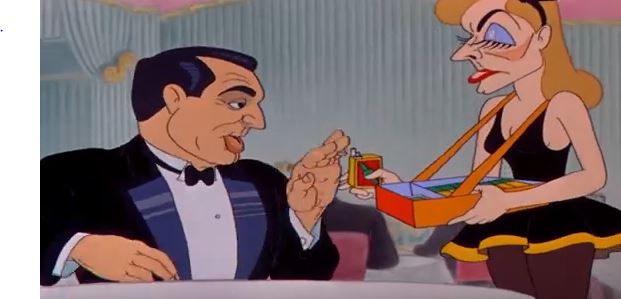
Make Mine Music (1946) and Melody Time (1948) are two of the series of five “anthology” animated features produced by Walt Disney in the 1940s. Most of the animation crew of the Disney studio were away serving in the military, and a reduced staff were left juggling some orphan story ideas. These cartoon collections were like a casserole made of leftovers, but quite delightful.I have a particular fondness for these Disney anthology features, which also include Saludos Amigos (1942), The Three Caballeros (1944), and Fun and Fancy Free (1947), which we covered in this previous post. Tied loosely by a general theme of music and folklore, the cartoons in each anthology are tune-filled, vibrant, and nostalgic. There are also restful. That’s kind of a funny thing to say about a cartoon, but I find them soothing. They are like half-remembered lullabies from childhood that still calm and entertain.
Make Mine Musicand Melody Time are both popular music cousins to the more distinguished Fantasia (1940), which sought to evoke animated stream-of-conscious visions to classical music. They also drift into the realm of folk tales. Both feature popular singers of the day, which is especially enjoyable.
The roster for Make Mine Music includes a segment called “Blue Bayou” with, literally, a blue bayou featuring trees, mirrored images on the water, and a pair of white herons to a sleepy tune by the Ken Darby Chorus.
Benny Goodman, the King of Swing, gives us “All the Cats Join In,” with striking minimalist animated style such as we would normally find at the innovative UPA studio of the era. We follow teens going to the malt shop in a peppy jive that’s really cool.
The minimalist cartoon style is continued in “A Ballad in Blue” with Andy Russell singing “Without You.” Moonlight on the water, moody, impressionistic, rain-washed.
Folk tales and “poetry corner,” as Bullwinkle and Rocky would say, with a rendition of the classic, “Casey at the Bat.” It’s a more or less musical recitation by the larger-than-life Jerry Colonna.
Dinah Shore sings “Two Silhouettes” in a Fantasia-like scene, and Sterling Holloway narrates “Peter and the Wolf.” The Goodman Quintet jams on “After You’ve Gone” in another Fantasia clone with images suggestive of Salvador Dali in the expression of sounds and the image of shifting sands.
The cute and unexpectedly poignant “Johnny Fedora and Alice Bluebonnet” follow the romantic adventures of a man’s hat and a lady’s hat, courtesy of The Andrews Sisters. If I can have my heart broken by a couple of cartoon hats that get separated because one of them gets bought, then I suppose it doesn’t take much to destroy me.
My favorite piece of Make Mine Music is the grand finale, the “Opera Pathetique” starring the resounding voice of Nelson Eddy, who portrays Willie the Whale, “The Whale Who Wanted to Sing at the Met.” Mr. Eddy narrates and sings the arias of the operatic hopeful whale. I love the image of the giant whale standing on his tail in a Pagliacci costume on the stage of the Metropolitan Opera House in New York. Most impressive is Nelson’s singing all three male voices in the Sextet segment of Lucia di Lammermoor. There is a sad ending to this tale, but as Bugs Bunny says of grand opera, “What did you expect, a happy ending?”
The Pied Pipers, the Kings Men, popular choral groups of the day also lend a hand, with the Kings Men doing a raucous takeoff on “The Martins and the Coys” hillbilly feud.
There is a fad now about adult coloring books. Most of the ones I’ve seen feature pages with evocative patterns of an almost psychedelic design. Coloring them in is supposed to be relaxing for us stressed adults. The fluid animated imaginings of these cartoons is likewise therapeutic.
Melody Time was released two years after Make Mine Music, and is quite similar in style. Freddy Martin and a frenetic cartoon bee take off in “Bumble Boogie” in the “Flight of the Bumble Bee.” The Andrews Sisters give us “Little Toot,” the tale of a junior tug boat who, despite his rascally ways, makes good in the clinch. Fred Waring and his Pennsylvanians are the background to the poem “Trees” by Joyce Kilmer, as dawn cascades over an impressionistic landscape, and diamonds of mist dot airy cobwebs.
Ethel Smith and the Dinning Sisters give us “Blame it on the Samba”. Making a guest appearance are two of the “three caballeros” – Donald Duck and Joe Carioca in a surreal and comical conga drum nightmare. I love Donald Duck in anything.
The grand finale to this collection is Roy Rogers and the Sons of the Pioneers telling us the tale of Pecos Bill. “Uncle Roy” spins the yarn for two young-uns played by Bobby Driscoll and Luana Patten, who also appeared in Disney’s Song of the South (1946) and So Dear to My Heart (1948).
I think my favorite segment of Melody Time, however, is the tale of Johnny Appleseed told and sung by the wonderful Dennis Day. He narrates, including doing different voices. Old Time Radio aficionados will know that Mr. Day was a terrific mimic, doing a variety of voices on The Jack Benny Show and other shows, and his crystal-clear tenor voice could soar, charm, and enchant. The cartoon character of Johnny Appleseed even looks like him.
The whimsical storytelling of these animated anthologies is perhaps less prestigious than the Disney full-length features, those projects where Disney swung for the fences, but there are small and significant gems here. They do not require as much an emotional investment from us, but they warm the heart. Nostalgic, certainly, and for some of us they literally recall our childhoods. I remember them not only from television, but from the projector in a grammar school assembly that was a Christmastime treat. They were gentle in tone, and none of them featured a wicked witch, which was a relief. Life is stressful enough sometimes, whether you’re seven or seventy-seven.
Take a look at several snippets of these cartoons on YouTube. It’ll take you back.
Also: just a note to draw your attention to the "free preview" box in the upper right corner for my book on Ann Blyth. Click on the cover and you get to read the first few chapters. Enjoy.
*****************************************"Lynch’s book is organized and well-written – and has plenty of amusing observations – but when it comes to describing Blyth’s movies, Lynch’s writing sparkles." - Ruth Kerr, Silver Screenings
"Jacqueline T. Lynch creates a poignant and thoroughly-researched mosaic of memories of a fine, upstanding human being who also happens to be a legendary entertainer." - Deborah Thomas, Java's Journey
"One of the great strengths of Ann Blyth: Actress. Singer. Star. is that Lynch not only gives an excellent overview of Blyth's career -- she offers detailed analyses of each of Blyth's roles -- but she puts them in the context of the larger issues of the day."- Amanda Garrett, Old Hollywood Films
"Jacqueline's book will hopefully cause many more people to take a look at this multitalented woman whose career encompassed just about every possible aspect of 20th Century entertainment." - Laura Grieve, Laura's Miscellaneous Musings
"Jacqueline T. Lynch’s Ann Blyth: Actress. Singer. Star. is an extremely well researched undertaking that is a must for all Blyth fans." - Annette Bochenek, Hometowns to Hollywood
Ann Blyth: Actress. Singer. Star. by Jacqueline T. Lynch
The first book on the career of actress Ann Blyth. Multitalented and remarkably versatile, Blyth began on radio as a child, appeared on Broadway at the age of twelve in Lillian Hellman's Watch on the Rhine, and enjoyed a long and diverse career in films, theatre, television, and concerts. A sensitive dramatic actress, the youngest at the time to be nominated for her role in Mildred Pierce (1945), she also displayed a gift for comedy, and was especially endeared to fans for her expressive and exquisite lyric soprano, which was showcased in many film and stage musicals. Still a popular guest at film festivals, lovely Ms. Blyth remains a treasure of the Hollywood's golden age.