Tampilkan postingan dengan label Edward G. Robinson. Tampilkan semua postingan

Kamis, 07 September 2017

Manpower - 1941


Manpower(1941) is quirky; at times a evoking the iconic working man of the WPA art images, but somehow never glorifying it.  It is a hard-bitten tale of the unlucky and the foolish, and yet manages to be unexpectedly humorous in spots. It’s not so much the movie doesn’t know what it is: it most certainly does, but it proudly and defiantly defies to be locked into any genre. Its stars George Raft, Edward G. Robinson, and Marlene Dietrich don’t care if we take them or leave them.  Director Raoul Walsh seems to have the same chip on his shoulder.

Images of great generators and turbines, of high tension wires and metal towers could provide a visual tribute to the great infrastructure projects of the 1930s when so much of America was finally electrified, but most of this background is used as a setting to reflect the esprit de corps of the cast of daring linemen.  They are not technicians as much as they are roustabouts, and they climb to the heavens with little to protect them from lightning or keep them from falling, but they are fatalistic, and bolstered with ego. 

The crew is packed with our old friends: Frank McHugh and Alan Hale as a couple of comic stumblebums; Ward Bond as a wiseacre; Eve Arden, too-little used in her role as a ten-cents-a-dance girl.  The linemen-roustabouts go to work at night in thunderstorms, and during their “high wire act” they talk about the dames.

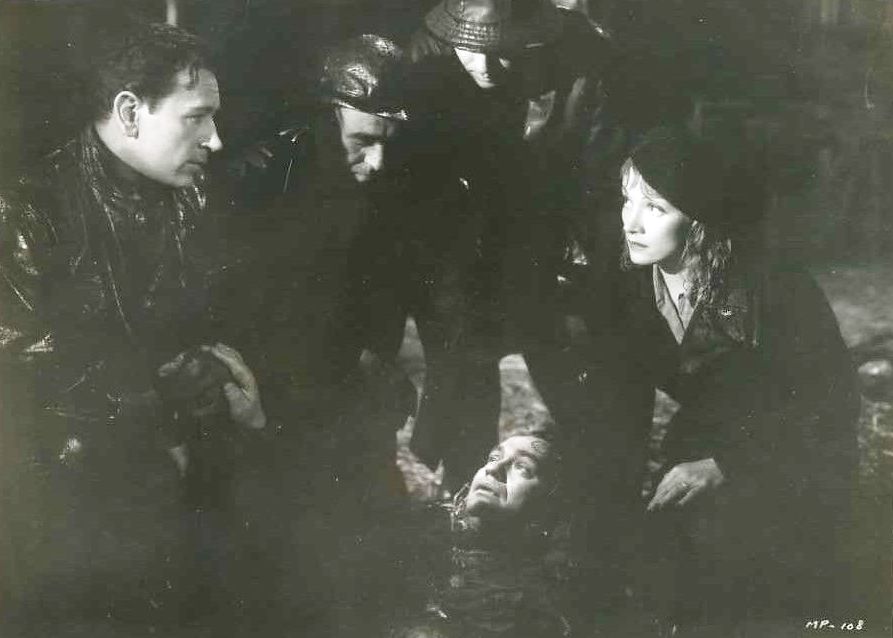
The wind, the lightning, the torrential rains, the sizzling live wires broken and flapping around them make for treacherous work. One older fellow, of course called “Pop,” played by Egon Brecher, warns of death by live wires. He is not a climber; he works on the ground. The most sensible guy is George Raft. His best buddy is Edward G Robinson, in a role markedly different from his sinister sneering gangsters and his shrewd detectives: he plays a happy-go-lucky, and hapless lineman desperate for a date, too awkward and bumbling to be attractive to the world-weary dance hall girls. He is exuberant, quick-tempered, but joyfully oblivious to the dangers around him. That includes the dangers from women as well as high wires. The when Raft gets into trouble upon the tower, Robinson comes to his aid and gets electrocuted. Ward Bond does a curious form of CPR by pressing on his back and brings him back to life, but Robinson’s leg is broken, so Edward G goes off to the hospital. His injury is such that he will not be fit for climbing towers anymore, but his heroism merits a promotion to foreman. This happy hooligan will stay on the ground from now on and direct the action.

Pop has a grim chore of his own. He is going to meet his daughter who has just been paroled from prison. He feels guilty about meeting her, because he abandoned her and her mother when she was a child and he feels responsible for her wayward course in life. He asks Raft, because he is the most sensible and unflappable guy around, to go with him to meet her. The daughter is played by Marlene Dietrich. Her black beret tells us she is sophisticated and tough (recall our post on the black beret in movies here). And glamorous, despite being a person.

There is an interesting scene where they stop to go to a drugstore so Marlene can pick up some cosmetics. George Raft was sometimes considered a kind of Humphrey Bogart 1.0 because his fame came along earlier than Bogart’s and he got a lot of the tough guy roles (and turned down a few that made Bogart famous). Raft was not the actor that Bogart was; he did not have his range, and yet there is something so wonderfully cool about Raft in this movie that I’m not sure Bogart could achieve. Raft is unruffled, even apathetic about Marlene’s needing to buy lipstick and powder, even steps in to help her shop, though he is somewhat disgusted by Marlene’s cold reception of her father. He does not know yet that she has had a hard life because her father abandoned her in childhood. Raft sits at the soda counter in a drugstore and orders a soda, with a straw. It is such a tough guy cool thing to do with a completely unconcerned attitude as he if just belted down a Scotch. He is one tough guy, and despite spending so much time up in the high wires, he is grounded.

All the happy hooligans appear to live together in a boarding house. They kid Edward G Robinson about his girl troubles. When Pop is killed on the job, Edward G., as foreman, has the miserable task of having to tell his next of kin – Marlene Dietrich. As usual George Raft gets drafted to go along with them because Raft is the sensible one, and just his coolness steadies the nerves of others. They break the news and Raft is disgusted by Marlene’s lack of grief. She actually hardly knew her father. But Edward G. warms up to her in a curiously courtly way. He does not chase her or push himself upon her the way he does the dance hall girls, but he is very gentle and feel sorry for her.

She gets a job at pretty much the only place she’s qualified to work: the dance hall, where we meet the other world-weary ladies including Eve Arden. Miss Eve refers to one of their clients as “laughing boy,” shades of her line in Mildred Pierce (1945). She is hard-bitten and wisecracking, but unfortunately, she doesn’t get quite the screen time as she did in other films, so it is a promise unfulfilled.

Edward G. pursues Marlene with naïve gallantry. He wants to buy her a present, so he takes Alan Hale and George Raft to go to a department store to buy her a négligée. Alan Hale has the funny lines about watching the live manikins model the clothing. He remarks, “How about some underwear? Can we see some models?” The movie is filled with sudden and surprising flicks of risqué dialogue and topical references that keeps the whole story off kilter and rides a fine line between a sophisticated farce and something utterly daffy. At times we don’t know if we’re dealing with Oscar Wilde or the Marx Brothers.

At one point Marlene sings in her own inimitable, and rather indescribable, fashion. George Raft has come to see her to warn her to stay away from his buddy. The owner of the joint, seeing George’s interest in Marlene says, “She’s got a great voice, huh?”

To which George responds, “Why don’t you get your ears tuned.” In one moment Marlene has been presented as a glamorous and exotic talent and in the very next moment she is insulted.

However, Edward G. proposes, Marlene excepts, not because she loves him – she tells him frankly that she does not – but with the attitude that this might be a new turn in her life for the better. After a raucous wedding reception in a Chinese restaurant with all the gang, the movie shifts interestingly to Marlene’s domestic abilities, which are considerable. Instead of showing her as the ex-con no-goodnik who hasn’t the slightest idea how to live like a decent person, we see she is remarkably domestic. She is an excellent cook. She keeps their house immaculate. She spoils Edward G. with appetizing treats and tries to be a good wife to him. Eventually it comes out bit by bit that, because her father left her mother, Marlene learned from a very young age how to keep the home fires burning. She had to take charge to cook, to care for her mother, to manage the household. When she turned to dance halls and crime it was not because of the love of the lurid excitement; indeed, that sort of life bores her silly. It was because she had no other skills and was too honest to market herself as a wife to the first man who came along.

Deciding on a change of course, she decides to take this second man who came along.

In another plot twist, Raft is injured at work – the setting is Southern California but evidently they have a whole lot of thunderstorms. Raft recovers in the hospital and when he is discharged, Edward G. insists on taking them home so that Marlene can nurse him. Raft warms up to her, sees that she is a nice person and a good wife and he feels comfortable and part of the family. We see, though he does not, that Marlene is falling in love with him. Eventually, she sees no hope in the situation but to be honest. She plans to leave Edward G. and go to Chicago and resume the life of a dance hall girl. Raft, upset that she would abandon his buddy demands an answer, and keeping with the honest course, tells him she’s in love with him.

In a final climactic scene, and yet another storm, there is a showdown in this tragic love triangle and, of course, in true movie fashion one of them has to go. I’ll give you a break this once and not give you a spoiler.
Manpowera good movie to consider for Labor Day in the sense that like so many movies of the 1930s and 1940s, much of the story involves working men in the setting of their jobs. (And reminds one of Slim-1937- which we covered here.) Sometimes the job is a theme of the movie, sometimes it is almost like another character in the movie, but if filmed today, the job would be relegated to only the setting of the story and not necessarily the meat of the story. In one sense, the common working man was given greater attention in movies back in Hollywood’s heyday, but in another sense, it is simply that the minutiae of everyday life was given greater attention back then. That is what makes films of that period so fascinating. They are like scrapbooks we can open and take our time and examine all the little things in the pictures, and have questions about and imagine all kinds of stories that are sidebars to the main story, but are just as interesting. One story inevitably leads to another.

Kamis, 10 Agustus 2017

We Hold These Truths - Hollywood Broadcast


A week after the attack on Pearl Harbor, a program celebrating the 150thanniversary of the Bill of Rights was produced on all four radio networks of the day – CBS, NBC Red and Blue networks, and the Mutual network.  It was narrated by James Stewart, and a host of Hollywood players joined him in bringing to life not only the struggles of post-Revolutionary War America to come up with this Bill of Rights, but how important it was to reflect on it, and rely on it, in a time of modern troubles.  The program was performed live.

It is a remarkable and deeply emotional dramatization that not only speaks to us today, but sings, shouts, cries, and cheers.  Norman Corwin wrote the beautiful script, performed on December 15, 1941, and it is estimated over half the U.S. population listened to it.  Performed in a Hollywood studio, live hookups also included performances in New York City, and an address by President Franklin D. Roosevelt from Washington, D.C.  Bernard Herrmann composed original music for the program, and at the very end of the show, Maestro Leopold Stokowski conducted “The Star Spangled Banner.”

James Stewart was, at that time, a corporal in the Army Air Corps, loaned to the project for the occasion.  His fellow players included Edward Arnold, Lionel Barrymore, Walter Brennan Marjorie Main, Bob Burns, Walter Huston, Edward G. Robinson, Rudy Vallee, and Orson Welles.

Walter Huston, rolling his r’s, introduces the program.  Then, the familiar voice of Lionel Barrymore is brought to the mic.

“My name is Barrymore. I’m one of several actors gathered in the studio in California….”  He joins 130 million fellow Americans in praise of a document “that men have fought for, that men are fighting for…”

He announces the cast, and adds, “Our names are meaningless unless your names are added.”  

Then one by one, the cast fills in, leaving their Hollywood personas and adopting the guise, in our imaginations, of post-Revolutionary Americans.  Jimmy Stewart like his character in Mr. Smith Goes to Washington (1939),which we covered in this post, leads us on a tour of modern Washington, D.C., and as he describes monuments and their inscriptions, we are reminded of the movie, for he is intentionally channeling Mr. Smith’s awe and wonder.  

Not only the message, but the script beams with elegant writing, no longer in fashion.  Perhaps it is too idealistic, and we have learned to distrust everything.  

On the National Archives building it is written,  “ What is past, is prologue.”  We hear the clicking of footsteps as Stewart climbs the stone steps to see the Bill of Rights in glass – the old parchment with faded writing.  Then Stewart and the other actors proceed to bring it alive.  “The words are dim, but not the meaning of the words…”  Perhaps not.  Perhaps we need this lesson.

Stewart brings us to the hall as the great men rise to speak and call the roll, to sign their names the draft when Constitution is written, which is then brought back to the states for review, but the people are suspicious.  They want guarantees of certain protections.  And so, this is the story of how the Bill of Rights came to be added as the most important addendum in history.  

Other actors jump in to be those common people in the different states who express their curiosity for the new document, but who want more guarantees, more explanations of just what they have won in the Revolutionary War.

Walter Huston is a blacksmith.   He doesn’t want anyone telling him he has to pray the way somebody else tells him.  Doesn’t like state religion.  Wants to make sure there won’t be any.

Others are suspicious of authority.  They know that just wanting law and order isn’t enough—Nero had such.   

Marjorie Main plays a woman whose husband died in the war.  She wants guarantees that he didn’t die  in vain.

Edward Arnold is a bricklayer who argues that the work is unfinished.  There’s only a foundation and no house.

So many voices, so much dissent, so much yearning for rights.   We are taken on a journey not only through history, but through the minds and souls of this nation.

Thomas Jefferson, Patrick Henry, James Madison lend their voices, and George Mason warning us not only about a monarchy, but a “tyrannical aristocracy” taking over, the monied class.

Now the First Congress begins sifting through the amendments to the Constitution and hammering them out for the future.  It’s not an easy job, but it’s important and they persist.  Stewart passionately narrates, cajoles, shouts.

Most profound is Orson Welles’ impassioned speech.  He takes over at this point and adds the other voices to the founders of the Bill of Rights – not just the men in Congress, but from the victims of the ages – “They had much help, the many nameless and unknown – from bleeding mouths, burnt flesh – from numberless and nameless agonies.  The delegates from dungeons, they were there.  The delegates from ashes at the bottoms of the stakes were there.”

We hear a voice, weak, pleading.

Orson continues, “The gallows delegates, whose corpses lifted gently in the breeze, they too…”

His voice grows booming, horrified:  “The Christians killed for being Christians, Jews for being Jews, the Quakers hanged in Boston town, they made a quorum also… The murdered men, the lopped off hands, the shattered limbs, the red welts where the whip lash bit into the back.  Must you know what they said?  Must you know how they argued?  Must you be told the evidence?

“Listen, then!”

We hear a blood-curdling scream.

“That was an argument for an amendment.”

They are words for our times, how shockingly, sickeningly current.

“How much of all this must be told to be believed?  How much of this must be diagramed: X marks the spot where decency was last observed?”

Nero was there, Caligula, Cotton Mather, all the tyrants were observing in the hall.  “All the long and bloody history of fanaticism, murder in the name of God.”  

Christ was there too.  “He, too, sat in the Congress, the mild Man, with scars in His hands and feet where the spikes went through.  He was a consultant in the business at hand.  Had He not died because the rulers of the realm denied free speech?  Was He not nailed up on a cross between two thieves because His preachments were considered treason?”

Orson growls, wails his words.  “Out of the agonies, out of crisscrossed scars of all the human race they made a Bill of Rights for their own people…To stand against the enemies within, connivers, fakers, those who lust for power, those who make of their authority an insolence.”

Listen to Orson’s impassioned speech, and think of now.

The Bill of Rights “Threw up a bulwark…and made a sign for their posterity against the bigots, the fanatics, bullies, lynchers, race haters, the cruel men, the spiteful men, the sneaking men, the pessimists…”

The Bill of Rights is ratified!  Jimmy Stewart breathes easier and brings the document to the thirteen states.

Then Edward Arnold, Walter Huston, Marjorie Main, Walter Brennan and others join in as the amendments are read, each one, and voices answer to illustrate what each one means.  We go to the homes of farmers, the blacksmith shop, all the new citizens.  The war gave them separation from Great Britain, but the Constitution and the Bill of Rights makes them citizens.

We hear a woman tending the grave of her soldier husband.  We hear a Colonial folk tune.  Through all, James Stewart’s folksy ruminating weaves a thread to guide us to the present.  Edward G. Robinson is a political protester who praises the rights that allow him to speak and fight corruption in city hall.

“A promise is a promise,” Jimmy Stewart says, “Has America’s been kept?”

It is a fair question, but in only a short time Japanese Americans would have their rights taken away by virtue of their ethnicity.  It was not the Bill of Rights that failed them; it was their fellow citizens and a president and government who shamefully allowed their mistreatment.  Even in those days when war was declared and Americans were coming together for mutual support, even in times of great pride, patriotism and cheerleading, something monstrously unfair could occur.  How much easier it is to occur in times when we are not one, when we are fighting amongst ourselves?  When a foreign enemy knows how to divide and conquer.  Abraham Lincoln said:

“From whence shall we expect the approach of danger? Shall some trans-Atlantic military giant step the earth and crush us at a blow? Never. All the armies of Europe and Asia...could not by force take a drink from the Ohio River or make a track on the Blue Ridge in the trial of a thousand years. No, if destruction be our lot we must ourselves be its author and finisher. As a nation of free men we will live forever or die by suicide.” 

We've come to that suicidal brink, however, with the aid of Vladimir Putin’s mafia, and the fascism that is rotting our government. We have far superior technology in our media than they did when this radio program was broadcast in December 1941, but we have lost the gift of eloquence that they possessed then.  Such well-written and carefully crafted words would today seem to be talking above the heads of the crowds whom the spokesmen try to reach.  Maybe because they are above the intelligence of the spokesmen.


This was a live program, so neatly coordinated, so passionately and intimately put together.  Listen to this program and marvel not only at how it was written, acted, and produced according to the technology of the day when we were only a week at war, but marvel – for God’s sake, marvel at the message of warning, of love, and of integrity, of pride for our Bill of Rights.

At the end of the program, James Stewart introduces in a soft, gentle voice President Roosevelt, who then speaks live from Washington, D.C.   “Ladies and gentlemen, the President of the people of the United States.”

Of the people.

It was reported by Screen Guide magazine in the March 1942 issue, from which some of these photos are taken, that after James Stewart introduced the President, he ripped off his earphones at the mic, and burst into tears.


Listen to We Hold These Truths or download at the Internet Archive, or here at YouTube.