Tampilkan postingan dengan label Alan Hale Sr. Tampilkan semua postingan

Kamis, 07 September 2017

Manpower - 1941


Manpower(1941) is quirky; at times a evoking the iconic working man of the WPA art images, but somehow never glorifying it.  It is a hard-bitten tale of the unlucky and the foolish, and yet manages to be unexpectedly humorous in spots. It’s not so much the movie doesn’t know what it is: it most certainly does, but it proudly and defiantly defies to be locked into any genre. Its stars George Raft, Edward G. Robinson, and Marlene Dietrich don’t care if we take them or leave them.  Director Raoul Walsh seems to have the same chip on his shoulder.

Images of great generators and turbines, of high tension wires and metal towers could provide a visual tribute to the great infrastructure projects of the 1930s when so much of America was finally electrified, but most of this background is used as a setting to reflect the esprit de corps of the cast of daring linemen.  They are not technicians as much as they are roustabouts, and they climb to the heavens with little to protect them from lightning or keep them from falling, but they are fatalistic, and bolstered with ego. 

The crew is packed with our old friends: Frank McHugh and Alan Hale as a couple of comic stumblebums; Ward Bond as a wiseacre; Eve Arden, too-little used in her role as a ten-cents-a-dance girl.  The linemen-roustabouts go to work at night in thunderstorms, and during their “high wire act” they talk about the dames.

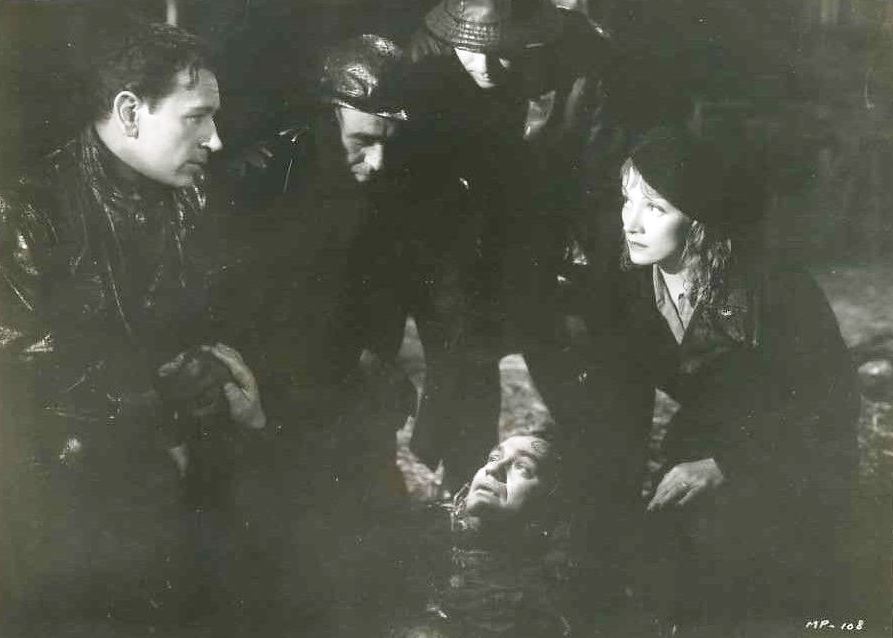
The wind, the lightning, the torrential rains, the sizzling live wires broken and flapping around them make for treacherous work. One older fellow, of course called “Pop,” played by Egon Brecher, warns of death by live wires. He is not a climber; he works on the ground. The most sensible guy is George Raft. His best buddy is Edward G Robinson, in a role markedly different from his sinister sneering gangsters and his shrewd detectives: he plays a happy-go-lucky, and hapless lineman desperate for a date, too awkward and bumbling to be attractive to the world-weary dance hall girls. He is exuberant, quick-tempered, but joyfully oblivious to the dangers around him. That includes the dangers from women as well as high wires. The when Raft gets into trouble upon the tower, Robinson comes to his aid and gets electrocuted. Ward Bond does a curious form of CPR by pressing on his back and brings him back to life, but Robinson’s leg is broken, so Edward G goes off to the hospital. His injury is such that he will not be fit for climbing towers anymore, but his heroism merits a promotion to foreman. This happy hooligan will stay on the ground from now on and direct the action.

Pop has a grim chore of his own. He is going to meet his daughter who has just been paroled from prison. He feels guilty about meeting her, because he abandoned her and her mother when she was a child and he feels responsible for her wayward course in life. He asks Raft, because he is the most sensible and unflappable guy around, to go with him to meet her. The daughter is played by Marlene Dietrich. Her black beret tells us she is sophisticated and tough (recall our post on the black beret in movies here). And glamorous, despite being a person.

There is an interesting scene where they stop to go to a drugstore so Marlene can pick up some cosmetics. George Raft was sometimes considered a kind of Humphrey Bogart 1.0 because his fame came along earlier than Bogart’s and he got a lot of the tough guy roles (and turned down a few that made Bogart famous). Raft was not the actor that Bogart was; he did not have his range, and yet there is something so wonderfully cool about Raft in this movie that I’m not sure Bogart could achieve. Raft is unruffled, even apathetic about Marlene’s needing to buy lipstick and powder, even steps in to help her shop, though he is somewhat disgusted by Marlene’s cold reception of her father. He does not know yet that she has had a hard life because her father abandoned her in childhood. Raft sits at the soda counter in a drugstore and orders a soda, with a straw. It is such a tough guy cool thing to do with a completely unconcerned attitude as he if just belted down a Scotch. He is one tough guy, and despite spending so much time up in the high wires, he is grounded.

All the happy hooligans appear to live together in a boarding house. They kid Edward G Robinson about his girl troubles. When Pop is killed on the job, Edward G., as foreman, has the miserable task of having to tell his next of kin – Marlene Dietrich. As usual George Raft gets drafted to go along with them because Raft is the sensible one, and just his coolness steadies the nerves of others. They break the news and Raft is disgusted by Marlene’s lack of grief. She actually hardly knew her father. But Edward G. warms up to her in a curiously courtly way. He does not chase her or push himself upon her the way he does the dance hall girls, but he is very gentle and feel sorry for her.

She gets a job at pretty much the only place she’s qualified to work: the dance hall, where we meet the other world-weary ladies including Eve Arden. Miss Eve refers to one of their clients as “laughing boy,” shades of her line in Mildred Pierce (1945). She is hard-bitten and wisecracking, but unfortunately, she doesn’t get quite the screen time as she did in other films, so it is a promise unfulfilled.

Edward G. pursues Marlene with naïve gallantry. He wants to buy her a present, so he takes Alan Hale and George Raft to go to a department store to buy her a négligée. Alan Hale has the funny lines about watching the live manikins model the clothing. He remarks, “How about some underwear? Can we see some models?” The movie is filled with sudden and surprising flicks of risqué dialogue and topical references that keeps the whole story off kilter and rides a fine line between a sophisticated farce and something utterly daffy. At times we don’t know if we’re dealing with Oscar Wilde or the Marx Brothers.

At one point Marlene sings in her own inimitable, and rather indescribable, fashion. George Raft has come to see her to warn her to stay away from his buddy. The owner of the joint, seeing George’s interest in Marlene says, “She’s got a great voice, huh?”

To which George responds, “Why don’t you get your ears tuned.” In one moment Marlene has been presented as a glamorous and exotic talent and in the very next moment she is insulted.

However, Edward G. proposes, Marlene excepts, not because she loves him – she tells him frankly that she does not – but with the attitude that this might be a new turn in her life for the better. After a raucous wedding reception in a Chinese restaurant with all the gang, the movie shifts interestingly to Marlene’s domestic abilities, which are considerable. Instead of showing her as the ex-con no-goodnik who hasn’t the slightest idea how to live like a decent person, we see she is remarkably domestic. She is an excellent cook. She keeps their house immaculate. She spoils Edward G. with appetizing treats and tries to be a good wife to him. Eventually it comes out bit by bit that, because her father left her mother, Marlene learned from a very young age how to keep the home fires burning. She had to take charge to cook, to care for her mother, to manage the household. When she turned to dance halls and crime it was not because of the love of the lurid excitement; indeed, that sort of life bores her silly. It was because she had no other skills and was too honest to market herself as a wife to the first man who came along.

Deciding on a change of course, she decides to take this second man who came along.

In another plot twist, Raft is injured at work – the setting is Southern California but evidently they have a whole lot of thunderstorms. Raft recovers in the hospital and when he is discharged, Edward G. insists on taking them home so that Marlene can nurse him. Raft warms up to her, sees that she is a nice person and a good wife and he feels comfortable and part of the family. We see, though he does not, that Marlene is falling in love with him. Eventually, she sees no hope in the situation but to be honest. She plans to leave Edward G. and go to Chicago and resume the life of a dance hall girl. Raft, upset that she would abandon his buddy demands an answer, and keeping with the honest course, tells him she’s in love with him.

In a final climactic scene, and yet another storm, there is a showdown in this tragic love triangle and, of course, in true movie fashion one of them has to go. I’ll give you a break this once and not give you a spoiler.
Manpowera good movie to consider for Labor Day in the sense that like so many movies of the 1930s and 1940s, much of the story involves working men in the setting of their jobs. (And reminds one of Slim-1937- which we covered here.) Sometimes the job is a theme of the movie, sometimes it is almost like another character in the movie, but if filmed today, the job would be relegated to only the setting of the story and not necessarily the meat of the story. In one sense, the common working man was given greater attention in movies back in Hollywood’s heyday, but in another sense, it is simply that the minutiae of everyday life was given greater attention back then. That is what makes films of that period so fascinating. They are like scrapbooks we can open and take our time and examine all the little things in the pictures, and have questions about and imagine all kinds of stories that are sidebars to the main story, but are just as interesting. One story inevitably leads to another.

Kamis, 16 Maret 2017

My Wild Irish Rose - 1947

My Wild Irish Rose (1947) is an example of post-World War II Hollywood nostalgia for simpler times, a rambling, ambitious entry in what I always felt should be its own separate genre—the musical about music composers.  It is artificial in the sense that it is cardboard cutout simplistic, yet beloved for its artifice, and is an unrelenting cutesy salute to the Irish. 

It is, in true Hollywood fashion, nothing more than a caricature of Irish Americans (Irish from Ireland, in some respects, have always felt that the Irish Americans were an odd caricature anyway), but that is just what Irish Americans are comfortable with, and so they seem happy enough with the garish cartoon.  Because this is a movie I recall from many a St. Patrick’s Day of my childhood, it carries, if not authenticity, then at least familiarity. I believe familiarity was all that the studios were aiming for when they made such movies, as homey as a hand-stitched sampler.

This is our first entry into a brief exploration over the next few weeks of that “genre”:  the musical about composers. 

Oddly enough, though My Wild Irish Rosepurports to be a biography of composer and lyricist Chauncey Olcott, there is no recognition of his participation in the creation of many American pop songs of musical theatre in the late 1800s and early 1900s, and depicts him only as a singer/actor.  His partnership with composers Ernest Ball and George Graff are left out of the film.  Though star Dennis Morgan sings snippets of many songs associated with Olcott: “My Wild Irish Rose,” “Mother Machree,” “TooRa Loo Ra Loo Ral,” and “When Irish Eyes Are Smiling,” the movie does not inform us that Chauncey  Olcott had a hand in creating and publishing these songs.  Olcott has been elected into the American Composers Hall of Fame, but you’d never know it from this movie.  Upon his death, one of his pallbearers was the great man of Broadway himself, and in many respects his “American” counterpart, George M. Cohan.

Just what the movie does accomplish is a little hard to say, except for an historically accurate representation of the 19th century minstrel show (scenes which may cause acute disgust and embarrassment today, though I feel any such scene is valuable if historically accurate), and for showcasing Dennis Morgan’s lovely tenor singing voice.

But not everybody was charmed, even in 1947.  What we may have forgiven over the years, what the critics of the day were less likely to overlook. This is from The New York Times of December 25, 1947:

“To say that My Wild Irish Rose tells a story is a gross overstatement, and, even in this season of extraordinary benevolence, one cannot truthfully say that there is a recommendable spirit to the interminable song, dance and specialty interludes that fill out this picture.  As an Irish tenor, Mr. Morgan's singing will hold best with the tone-deaf, and that brogue he affects, and let's not overlook Alan Hale either in this regard, is—just call it murderous.  Indeed, the whole atmosphere of the film is so patronizing and professionally Irish in sentiment that it is downright embarrassing.”

Did the reviewer not find the minstrel affectations embarrassing?  Hmm.


I give the movie full marks if only for casting William Frawley as William J. Scanlan, the grand old man of nineteenth century Irish-themed operettas whom Chauncey Olcott was fated to replace.

And for giving our old friend Grady Sutton a brief role (we discussed Grady in this previous post).  And for casting dear Sara Allgood as Chauncey’s mother.  Trivia buffs may also note that Ruby Dandridge, the mother of Dorothy Dandridge, plays the maid of famed musical theatre star Lillian Russell; and little Kristen Morgan, Dennis Morgan’s real-life daughter, makes a brief appearance as a little girl to whom he sings on stage. 

We won’t discover too much about Chauncey Olcott’s life from this movie, but that should cease to be a surprise about any Hollywood biography.  What we have is John Chancellor Olcott of Buffalo, New York, who runs away from home and a job on a tug boat to make his fortune on the stage; gets involved with a traveling minstrel show; meets Andrea King, who plays Lillian Russell; falls in love with Arlene Dahl, whose da, Alan Hale, thinks he’s not good enough for his little girl.  George Tobias plays a Greek businessman who trails Dennis Morgan throughout the movie with malapropos babble.  George O’Brien is his body builder pal who beats up people who are mean to Dennis, and Ben Blue is his bumbling misfit pal.

Chauncey gets to New York, charms the Tenderloin, replaces the sickly William Frawley with an Irish accent even phonier than Frawley’s (which the movie notes with wry humor and is therefore the most honest thing about the tale).

We may smile over a scene set at Delmonico’s, and at Ruby Dandridge’s wondering how flowers can be “wired” to arrive at a dressing room “how  do they send flowers over telegraph wires?” and Lillian Russell doesn’t know, either.  I love all scenes set in theaters, the plush atmosphere, the palace-like settings, the communal nature from the box to the balcony.

Olcott’s great influence on American pop music before World War I would have made a better movie, and though the story is supposedly based on a book his widow wrote of his life, the thin romance spread across too many years and miles with Arlene Dahl (in her first featured movie role) is a weak story thread; he always seems to spend more time with George O’Brien and Ben Blue.  Dennis Morgan plays a man driven to sing, yet we rarely hear him finish a song in the endless array of montages.

It’s a Technicolor movie, but the predominant shade is green.  Irish-American green, as cartoonish as a box of Lucky Charms.  But that’s all it’s supposed to be.  That is what Americans have created of St. Patrick’s Day.

What should also be noted is the camaraderie, the blending of ethnic groups, the mutual kidding, even the foolish minstrelsy, displays a younger
America more comfortable with itself, more frankly acknowledging of its melting pot.  To be American was to be hyphenated because all save the descendants of native tribes were products of immigrant families.   It was okay to be an immigrant; it was worn like a badge of honor.  The point was they chose to be Americans, and in doing so, honoring we who were born here.

Chauncey Olcott and friend


You can have a listen to this rare audio of the real Chauncey here on YouTube.


Happy St. Patrick’s Day to all who celebrate it.
*********************
My scheduled talk at the Agawam Historical Association on Wednesday was changed to tonight at 7 p.m., due to the blizzard.

- I'll be speaking about my book on the Ames Manufacturing Company of Chicopee, Mass. and its importance during the Civil War for the Agawam Historical Association, at the Captain Leonard House, 663 Main Street, Agawam, Mass.  Free and open to the public, the time is 7 p.m.
​
Saturday, March 18, 2017 - I'll be speaking about Comedy and Tragedy on the Mountain at Blue Umbrella Books, 2 Main Street, Westfield, Mass., free and open to the public, 3 p.m.


The time:  1895 to 1965

Setting:  A wooden, barn-like summer playhouse…in an amusement park…on the top of a mountain…in a New England factory town

It was as unlikely a place as you will find for stage plays, but as much a part of the community as the stores and businesses and the red brick maze of factories and canals down below the mountain in the so-called “Flats” by the Connecticut River.  The place was Holyoke, Massachusetts.  For some seventy years live theatre created magic on the mountain above the city.


Though a small theater may seem like a world unto itself, it is not; not entirely.  It reflects its era and its location, that larger world outside its wooden walls; therefore this story is as much about Holyoke, the tri-city area of Holyoke-Chicopee-Springfield, and the Pioneer Valley of western Massachusetts, because this was the audience for the little playhouse on Mt. Tom.  If you are familiar with these towns, then you will find much in this book to jog your memories, for this is your story.

Comedy and Tragedy on the Mountain covers seventy years of live theatre on Mt. Tom, from vaudeville, operetta, WPA-sponsored shows in the Great Depression, and its heyday from 1941 to 1962 with a resident repertory company called The Valley Players.  In the early 1960s, two new incarnations: The Casino-in-the-Park, and finally, the Mt. Tom Playhouse with touring packaged shows featuring well-known stars from television and movies.  Many stars of stage and screen, and many newcomers who would one day become stars, performed over several decades on Mt. Tom.  Through interviews, newspaper reviews, and many photographs, you will relive their performances, and go backstage for personal experiences that were both comic and tragic, and enjoy again the excitement of opening night.

***

Speaking of opening nights, I'd like to extend best wishes to the two theatre companies that will be performing my play Sketching the Soul this month.  The first is the Hummingbird Theatre Company of Rochester, New York.  They open tonight, Thursday the 16th:


Hummingbird Theatre Company (formerly BART Productions) presents: Sketching the Soul


by Jacqueline Lynch 
Directed by Donald B. Bartalo


Thur. March 16th - 7:30pm
Fri. March 17th - 7:30pm
Sat. March 18th - 7:30pm
Sun. March 19th - 2:00pm
Thur. March 23rd - 7:30pm
Fri. March 24th - 7:30pm
Sat. March 25th - 7:30pm


Chelsea Logan is an artist struggling with the conflict between her growing celebrity and her Amish upbringing, which she left behind to pursue her ambition, and which she neglected to mention to Mike (her boyfriend), new friends and colleagues.

The past and present, celebrity and spiritually come to a head one frenetic weekend when her younger sister Sarah arrives unexpectedly. Chelsea must explain her sister, and the lifestyle she kept a secret, to Mike, an attorney struggling with his own ethical priorities, and to Maureen Nash an aggressive journalist who arrives with a photographer for an interview (during which Chelsea, with a rather un-Amish-like attitude, pummels the photographer into surrendering the film he has shot of Sarah!) Sarah and Mike together help Chelsea to accept and acknowledge the power of her Amish heritage and to move toward a future she had not expected.

CAST

CHELSEA LOGAN…………….……………Sara Bickweat Penner

MIKE GRIMALDI…………………………..Brian Tan

SARAH RICHTER………………………….Laura Thompson Pratt

NANCY………………………………………….Stephanie Sheak

MAUREEN NASH…………………………..Denise Bartalo

ARTHUR COAKLEY……………………….Joseph Barcia

Tickets are $12 in advance and $15.00 at the door. 

****************
The second group to perform this same play will be the Belhaven University Theatre Department in Jackson, Mississippi.  They run March 30th to April 1st, directed by Dr. Elissa Sartwell.

Cast
JAMES KENYON as Mike Grimaldi
LECI GRAY as Chelsea Logan
OLIVIA SIMMS as Nancy
RILEY PLEASANTS as Sarah Richter
RACHEL BROOME as Maureen Nash
MAC MITCHELL as Arthur Coakley

Production Staff & Crew
Director: Dr. Elissa Sartwell
Stage Manager: Frannie Maas
Scenic Design: Hannah Kenyon
Technical Director/Lighting Design: Michael Tobin
Costume & Hair/Makeup Design: Alice Bryant
Sound Design: Brittany Lyday
Props Master: Laina Faul
Dresser/Run Crew: Grace Reeves

Admission $10; Seniors/Students $5; Complimentary admission for Belhaven students, faculty, staff and their immediate families. Doors open 30 minutes prior to each performance. We hope that you will join us at the theatre! To reserve tickets for any Belhaven Theatre production, please call 601-965-7026 or email your request to boxoffice@belhaven.edu. Tickets may be purchased with cash or check.

My thanks and very best wishes to both companies.  Break a leg!