Tampilkan postingan dengan label Rudy Vallee. Tampilkan semua postingan

Kamis, 10 Agustus 2017

We Hold These Truths - Hollywood Broadcast


A week after the attack on Pearl Harbor, a program celebrating the 150thanniversary of the Bill of Rights was produced on all four radio networks of the day – CBS, NBC Red and Blue networks, and the Mutual network.  It was narrated by James Stewart, and a host of Hollywood players joined him in bringing to life not only the struggles of post-Revolutionary War America to come up with this Bill of Rights, but how important it was to reflect on it, and rely on it, in a time of modern troubles.  The program was performed live.

It is a remarkable and deeply emotional dramatization that not only speaks to us today, but sings, shouts, cries, and cheers.  Norman Corwin wrote the beautiful script, performed on December 15, 1941, and it is estimated over half the U.S. population listened to it.  Performed in a Hollywood studio, live hookups also included performances in New York City, and an address by President Franklin D. Roosevelt from Washington, D.C.  Bernard Herrmann composed original music for the program, and at the very end of the show, Maestro Leopold Stokowski conducted “The Star Spangled Banner.”

James Stewart was, at that time, a corporal in the Army Air Corps, loaned to the project for the occasion.  His fellow players included Edward Arnold, Lionel Barrymore, Walter Brennan Marjorie Main, Bob Burns, Walter Huston, Edward G. Robinson, Rudy Vallee, and Orson Welles.

Walter Huston, rolling his r’s, introduces the program.  Then, the familiar voice of Lionel Barrymore is brought to the mic.

“My name is Barrymore. I’m one of several actors gathered in the studio in California….”  He joins 130 million fellow Americans in praise of a document “that men have fought for, that men are fighting for…”

He announces the cast, and adds, “Our names are meaningless unless your names are added.”  

Then one by one, the cast fills in, leaving their Hollywood personas and adopting the guise, in our imaginations, of post-Revolutionary Americans.  Jimmy Stewart like his character in Mr. Smith Goes to Washington (1939),which we covered in this post, leads us on a tour of modern Washington, D.C., and as he describes monuments and their inscriptions, we are reminded of the movie, for he is intentionally channeling Mr. Smith’s awe and wonder.  

Not only the message, but the script beams with elegant writing, no longer in fashion.  Perhaps it is too idealistic, and we have learned to distrust everything.  

On the National Archives building it is written,  “ What is past, is prologue.”  We hear the clicking of footsteps as Stewart climbs the stone steps to see the Bill of Rights in glass – the old parchment with faded writing.  Then Stewart and the other actors proceed to bring it alive.  “The words are dim, but not the meaning of the words…”  Perhaps not.  Perhaps we need this lesson.

Stewart brings us to the hall as the great men rise to speak and call the roll, to sign their names the draft when Constitution is written, which is then brought back to the states for review, but the people are suspicious.  They want guarantees of certain protections.  And so, this is the story of how the Bill of Rights came to be added as the most important addendum in history.  

Other actors jump in to be those common people in the different states who express their curiosity for the new document, but who want more guarantees, more explanations of just what they have won in the Revolutionary War.

Walter Huston is a blacksmith.   He doesn’t want anyone telling him he has to pray the way somebody else tells him.  Doesn’t like state religion.  Wants to make sure there won’t be any.

Others are suspicious of authority.  They know that just wanting law and order isn’t enough—Nero had such.   

Marjorie Main plays a woman whose husband died in the war.  She wants guarantees that he didn’t die  in vain.

Edward Arnold is a bricklayer who argues that the work is unfinished.  There’s only a foundation and no house.

So many voices, so much dissent, so much yearning for rights.   We are taken on a journey not only through history, but through the minds and souls of this nation.

Thomas Jefferson, Patrick Henry, James Madison lend their voices, and George Mason warning us not only about a monarchy, but a “tyrannical aristocracy” taking over, the monied class.

Now the First Congress begins sifting through the amendments to the Constitution and hammering them out for the future.  It’s not an easy job, but it’s important and they persist.  Stewart passionately narrates, cajoles, shouts.

Most profound is Orson Welles’ impassioned speech.  He takes over at this point and adds the other voices to the founders of the Bill of Rights – not just the men in Congress, but from the victims of the ages – “They had much help, the many nameless and unknown – from bleeding mouths, burnt flesh – from numberless and nameless agonies.  The delegates from dungeons, they were there.  The delegates from ashes at the bottoms of the stakes were there.”

We hear a voice, weak, pleading.

Orson continues, “The gallows delegates, whose corpses lifted gently in the breeze, they too…”

His voice grows booming, horrified:  “The Christians killed for being Christians, Jews for being Jews, the Quakers hanged in Boston town, they made a quorum also… The murdered men, the lopped off hands, the shattered limbs, the red welts where the whip lash bit into the back.  Must you know what they said?  Must you know how they argued?  Must you be told the evidence?

“Listen, then!”

We hear a blood-curdling scream.

“That was an argument for an amendment.”

They are words for our times, how shockingly, sickeningly current.

“How much of all this must be told to be believed?  How much of this must be diagramed: X marks the spot where decency was last observed?”

Nero was there, Caligula, Cotton Mather, all the tyrants were observing in the hall.  “All the long and bloody history of fanaticism, murder in the name of God.”  

Christ was there too.  “He, too, sat in the Congress, the mild Man, with scars in His hands and feet where the spikes went through.  He was a consultant in the business at hand.  Had He not died because the rulers of the realm denied free speech?  Was He not nailed up on a cross between two thieves because His preachments were considered treason?”

Orson growls, wails his words.  “Out of the agonies, out of crisscrossed scars of all the human race they made a Bill of Rights for their own people…To stand against the enemies within, connivers, fakers, those who lust for power, those who make of their authority an insolence.”

Listen to Orson’s impassioned speech, and think of now.

The Bill of Rights “Threw up a bulwark…and made a sign for their posterity against the bigots, the fanatics, bullies, lynchers, race haters, the cruel men, the spiteful men, the sneaking men, the pessimists…”

The Bill of Rights is ratified!  Jimmy Stewart breathes easier and brings the document to the thirteen states.

Then Edward Arnold, Walter Huston, Marjorie Main, Walter Brennan and others join in as the amendments are read, each one, and voices answer to illustrate what each one means.  We go to the homes of farmers, the blacksmith shop, all the new citizens.  The war gave them separation from Great Britain, but the Constitution and the Bill of Rights makes them citizens.

We hear a woman tending the grave of her soldier husband.  We hear a Colonial folk tune.  Through all, James Stewart’s folksy ruminating weaves a thread to guide us to the present.  Edward G. Robinson is a political protester who praises the rights that allow him to speak and fight corruption in city hall.

“A promise is a promise,” Jimmy Stewart says, “Has America’s been kept?”

It is a fair question, but in only a short time Japanese Americans would have their rights taken away by virtue of their ethnicity.  It was not the Bill of Rights that failed them; it was their fellow citizens and a president and government who shamefully allowed their mistreatment.  Even in those days when war was declared and Americans were coming together for mutual support, even in times of great pride, patriotism and cheerleading, something monstrously unfair could occur.  How much easier it is to occur in times when we are not one, when we are fighting amongst ourselves?  When a foreign enemy knows how to divide and conquer.  Abraham Lincoln said:

“From whence shall we expect the approach of danger? Shall some trans-Atlantic military giant step the earth and crush us at a blow? Never. All the armies of Europe and Asia...could not by force take a drink from the Ohio River or make a track on the Blue Ridge in the trial of a thousand years. No, if destruction be our lot we must ourselves be its author and finisher. As a nation of free men we will live forever or die by suicide.” 

We've come to that suicidal brink, however, with the aid of Vladimir Putin’s mafia, and the fascism that is rotting our government. We have far superior technology in our media than they did when this radio program was broadcast in December 1941, but we have lost the gift of eloquence that they possessed then.  Such well-written and carefully crafted words would today seem to be talking above the heads of the crowds whom the spokesmen try to reach.  Maybe because they are above the intelligence of the spokesmen.


This was a live program, so neatly coordinated, so passionately and intimately put together.  Listen to this program and marvel not only at how it was written, acted, and produced according to the technology of the day when we were only a week at war, but marvel – for God’s sake, marvel at the message of warning, of love, and of integrity, of pride for our Bill of Rights.

At the end of the program, James Stewart introduces in a soft, gentle voice President Roosevelt, who then speaks live from Washington, D.C.   “Ladies and gentlemen, the President of the people of the United States.”

Of the people.

It was reported by Screen Guide magazine in the March 1942 issue, from which some of these photos are taken, that after James Stewart introduced the President, he ripped off his earphones at the mic, and burst into tears.


Listen to We Hold These Truths or download at the Internet Archive, or here at YouTube.


Kamis, 07 April 2016

Evolution of the Classic Film Fan


Jack Lemmon arrives home late at night to his New York City apartment, a second-floor walk-up in an ancient brownstone.  It’s a cold, misty night in the late autumn.  He pops a TV dinner in the oven, and when it’s ready, he drops the hot aluminum foil slab on his coffee table and parks himself in front of the TV.  He is cheered by the prospect of Grand Hotel (1932) being broadcast, but is fed up with commercial sponsor interruptions by the announcer, and flicks channels (surprisingly, on an early cable manual remote dial), runs through a western and another show that do not hold his interest, before he lands back on Grand Hotel and finally gives up at yet another commercial.  He snaps off the TV, and it blips into a single white spot, as if the cathode ray tube has been engulfed in a cosmic black hole.

Had his character, C.C. Baxter ever seen this, then 28-year-old movie, before?  Or had he only heard of it?  He is clearly excited at the prospect of seeing it as the announcer trumpets the names of the cast, including Joan Crawford and Lionel Barrymore.

Most of us recognize this scene from The Apartment (1960).  It always fascinated me as possibly one of the first depictions of the old movie buff.  Today we discuss the evolution of the classic film fan, which, as we’ve mentioned on this blog before, was a result of television.

January 25, 1957

In this previous post we took a playful look at some pages of TV Guide from 1976 and the old movie listings.  Here are a few much older pages from the 1950s and 1960s.  Though there were only a few channels then, there was still a lot of time to fill on this new medium, and movies from decades past were pulled out of the vault and used as filler.

But it was also an exciting era of entertainment in a new format.  Dramas, many of them live, featured stars and character actors of Hollywood’s Golden Age.   We might wonder how they felt about sharing the airwaves with old movies featuring their much younger selves?   Here was graphic proof that they had aged—not something helpful in promoting a current career in middle age.  (Catch Claude Rains in an episode of The Naked City below, and Gloria Swanson starring in her own program.)  It's difficult enough to compete against other actors, but to compete against one's younger self?


November 9, 1960


February 8, 1955


The studios were breaking up or had broken up by this time, and the broadcast rights to these movies were sometimes held by no one connected with the making of them.  Certainly, none of the actors received residuals.

But it must have seemed amazing that these old movies—which most studio execs back in the day could never have imaged would have a life beyond the vault—were now being shown to a new generation.  A few “art house” movie theaters across the country might chime in with a retrospective  on a particular film or star, but none of these venues could claim the huge audience numbers of a single night of television.

The 1960s, so forward, fast-moving, and futuristic, was not a particularly nostalgic period, though we see on this TV Guide page an early documentary series, Hollywood and the Stars.  Most remarkably, though, have a look at Silents Please, a program which showed silent movies and listed the credits.


October 7, 1963


October 3, 1962

Most Baby Boomers, though having benefited from the Late Late Show, the Million Dollar Movie, etc., since the 1950s, would recall the 1970s and the curious nostalgia boom as the mechanism that really launched a generation of old movie buffs. 

That’s Entertainment!(1974) had a huge hand in launching it.  Originally intended as a television special for the 50th anniversary of MGM, producer and director Jack Haley, Jr. and the studio execs decided to gamble on a feature release, and its popularity surprised everyone and led to a soundtrack album of highlights.  (I don’t really remember, but I think it could have been one of the first albums I ever bought.) The tag line “Boy.  Do we need it now.” was both an acknowledgement of the fatigue over the political and social upheaval over the past several years, and a slap in the face to modern movie makers, whose style and subject matter were vastly different from the classic era.  It was one of the highest grossing films of the year.  

Aha.  There was a market for this old-time stuff.

The clips are wonderful, but some of the film's most powerful moments are the introductions to each segment hosted by stars of the Golden Age on the run-down sets of the back lot.  These scenes of aging star reviving warm memories of elegance -- on a dilapidated set rotting away -- hammer home the lure of nostalgia like nothing else.

Here is a clip of the festivities and roll call of the stars from the 1974 premiere.  These stars need not have worried about competing with their younger selves anymore. That was water over the bridge.  They could look back safely, and even enjoy being in the limelight for one more special evening.

And for the first time, their fans shouting at them as they walked the red carpet were not their contemporaries -- they were young enough to be their children and grandchildren.

But some modern movie makers, perhaps spurring the nostalgia era, perhaps capitalizing off it, paid tribute to Hollywood’s golden age.  What’s Up Doc? (1972) was a modern film, but a direct tribute to the screwball classics of decades past.  Paper Moon (1973) was not a parody, but a slice of life of Depression-era America, filmed in black and white.  The Sting (1973), decidedly in color, a planned art deco palette.  Young Frankenstein (1974)—also filmed in glorious black and white— represented the most common tribute to classic film in this era—the parody.  Add to this Neil Simon’s The Cheap Detective (1978), a knockoff on Casablanca (1943) and The Maltese Falcon (1941).

During this era we can thank The Carol Burnett Show for making us laugh with superb old movie parodies.  Parodies, and kitschy merchandise (Betty Boop was reborn as key rings and coffee mugs long before anybody thought of rebroadcasting the old cartoons.) fed the old movie nostalgia boom, and a few slim books that tried to cram names and facts if not a deep understanding or analysis of film at this time.


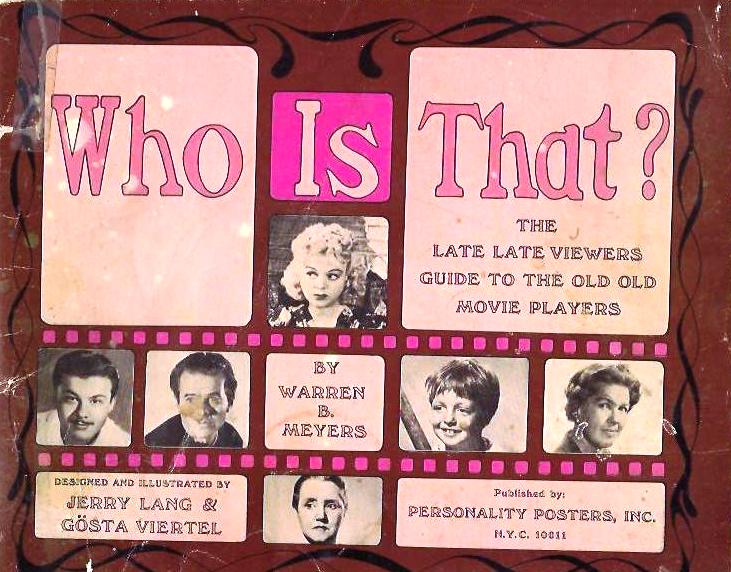
Such books include Richard Lamparski’s Whatever Became Of…?series, and Jerry Lang and Gösta Viertel’s Who Is That? and many others.  These were photo-filled books, lightweight, without much depth to them, but certainly a kind of survey course for newcomers.   Most had little substantive narrative, with a reliance on cliche, and sometimes, as in the case of Who Is That?, an awkward handling certainly in the "separate but equal" gallery of “Negro Actors” along with a roster of vamps and bad guys.  These high school yearbook-style books at least put a name to the face, long before IMDb gave us movie credits.  In all these ways, serious and spurious, the decade was waking up to classic films.


One could argue the chicken-and-egg scenario: did these items feed off the merchandising craze of the nostalgia boom, or did it create it?

Critics and film historians Pauline Kael and Jeanine Basinger wrote contemplative essays on classic film, and colleges began film appreciation courses.  Leonard Maltin published his first book of reviews, which would be updated for the first time during the decade, and, of course, Robert Osborne’s  Academy Awardsannual became bibles in the homes of movie buffs.

The term "film noir" came into popularity in the 1970s.  

Those of us who were around then, educating ourselves on classic film from public library encyclopedias and biographies, and many late nights in front of the cathode ray tube, welcomed these and That’s Entertainment and it’s sequel.  It was fun to be reminded of great musicals in an era where they were dying and we were told they would never come back because they were too expensive, but mostly too corny.  Its success, and that teasing moniker, “Boy. Do We Need It Now.” seemed to legitimize our love of old movies.

Television remained our main source for classic film, and in an era where old movies were often shown on primetime, we recall that the very first showings on TV of Gone With the Wind (1939) in 1976 (engendering a famous Carol Burnett parody), and The Sound of Music(1965) in 1975 were huge events and received the highest ratings of the era.  Subsequent yearly showings continued to reap great ratings and became annual favorites for new generations.

Interesting that The Wizard of Oz (1939), another film that received a huge boost from TV and probably would have been forgotten without it, really took off with the advent of color TV, where its special effects could be better appreciated.

I don't believe The Wizard of Oz has been shown on broadcast TV in years.


Another TV tribute—and I’d love to see how many remember this—was the series run on PBS stations called Matinee At the Bijou  in 1980 and ran for five years.  It was probably a first for showing in each episode a cartoon, a short subject, and a serial or “B” movie.  Rudy Vallee was brought out of retirement to sing the show’s theme song.  It was a real treat for the old movie fan to have access to these less prestigious examples of the studio era.  All well and good to celebrate Casablanca, but for the serious film buff, the giants do not tell the whole story, nor satisfy our yen for what else is in the vault.

On the horizon—a tsunami.  The VHS cassette.  Old movies were now being produced in video format to be purchased for home use.  To be sure, collectors of 16mm print films had enjoyed a select assortment of classic films, shorts and cartoons for decades (and some still prefer them), but the VHS cassette offered a less expensive alternative that was easier to use, required less equipment, and a larger variety of movies.  Icing on the cake was the ability to actually record on blank video tape at home.  Now the Late, Late Show offerings were funneled into our private collections.

Watching a particular movie anytime you wanted.  Mind blowing.  A Flintstones-era  “on demand” TV.

And THEN came the movie rental shop.  And “please rewind.”

DVD, of course, was the next big advancement, and Blu-ray, but even before this came on the scene, what I think was more profound to the evolution of the old movie buff and the perpetuation of familiarity with classic films to a new generation was the American Movie Classics channel, and its hosts Bob Dorian and Nick Clooney.   It ran from 1984 to 2002 and was our go-to network for classic movies.  Since AMC (now called American Movie Channel) abandoned classic film programming in 2002, there is always that reference to their going to the “dark side” and fears that one day Turner Classic Movies might follow their example. 

TCM, launched in 1994, I think we can all acknowledge, has been a giant in the appreciation of classic film.  No other TV source has promoted the wide array of studio era films—from features, to shorts, documentaries, live events such as the TCM Film Festival and the TCM Classic Cruise.  We may scorn its drifting into modern films, and the trite “let’s movie” slogan, but TCM is a haven for classic film buffs in a way no other venue has been, not since the old neighborhood movie house from the teens to the late 1950s.  Robert Osborne has earned the respect and love of millions of classic film fans for many reasons, most especially for the dignity with which he presents the movies, for the way he represents us.  Not since the “Boy. Do We Need It Now.” has the appreciation of classic films been raised to the level of esteem it deserves.

We may have reached a climax of sorts—for, as discussed in the first part of this series here, the demographic of the Millennials do not get their entertainment from cable television.  With few classic films shown on broadcast TV these days, younger generations are not apt to be introduced to classic film just by switching the dial, as we were, if they do not subscribe to TCM.

But there are some interesting new venues to promote classic films.  Blogs and websites certainly, but also the growing experiment of showing old movies in cinemas for special releases, allowing fans to see their favorites once again on the big screen.

There are also some intriguing home-grown programming—such as Dana Hersey, who hosted The Movie Loft on Boston-area TV-38 in the 1980s is launching an Internet classic movie streaming channel. Other hosts of online podcasts demonstrate that being a classic film fan is continually evolving according to the technology that allows us to appreciate old movies.  No longer content to be “programmed to”, the classic film fan is now taking the reins and doing the programming.  We'll talk about that more later in the year.

Come back next month, Thursday, May 5th, for part 5 of this series when we discuss the TCM Classic Film Festival.

Come back next week for our regularly scheduled programming—the CMBA “Words! Words! Words!” Blogathon.  My entry is the use of letters in old movies.  Please join us next Thursday for this fun blogathon.

Part 1 of the year-long series on the current state of the classic film buff is here: A Classic Film Manifesto. 


****************************

"Lynch’s book is organized and well-written – and has plenty of amusing observations – but when it comes to describing Blyth’s movies, Lynch’s writing sparkles." - Ruth Kerr, Silver Screenings

"Jacqueline T. Lynch creates a poignant and thoroughly-researched mosaic of memories of a fine, upstanding human being who also happens to be a legendary entertainer." - Deborah Thomas, Java's Journey

"One of the great strengths of Ann Blyth: Actress. Singer. Star. is that Lynch not only gives an excellent overview of Blyth's career -- she offers detailed analyses of each of Blyth's roles -- but she puts them in the context of the larger issues of the day."- Amanda Garrett, Old Hollywood Films

"Jacqueline's book will hopefully cause many more people to take a look at this multitalented woman whose career encompassed just about every possible aspect of 20th Century entertainment." - Laura Grieve, Laura's Miscellaneous Musings

"Jacqueline T. Lynch’s Ann Blyth: Actress. Singer. Star. is an extremely well researched undertaking that is a must for all Blyth fans." - Annette Bochenek, Hometowns to Hollywood


Ann Blyth: Actress. Singer. Star.
 
by Jacqueline T. Lynch

The first book on the career of actress Ann Blyth. Multitalented and remarkably versatile, Blyth began on radio as a child, appeared on Broadway at the age of twelve in Lillian Hellman's Watch on the Rhine, and enjoyed a long and diverse career in films, theatre, television, and concerts. A sensitive dramatic actress, the youngest at the time to be nominated for her role in Mildred Pierce (1945), she also displayed a gift for comedy, and was especially endeared to fans for her expressive and exquisite lyric soprano, which was showcased in many film and stage musicals. Still a popular guest at film festivals, lovely Ms. Blyth remains a treasure of the Hollywood's golden age.


The eBook and paperback are available from Amazon and CreateSpace, which is the printer.  You can also order it from my Etsy shop. It is also available at the Broadside Bookshop, 247 Main Street, Northampton, Massachusetts.

If you wish a signed copy, then email me at JacquelineTLynch@gmail.com and I'll get back to you with the details.

**************************
My new syndicated column SILVER SCREEN, GOLDEN YEARS, on classic film is up at Go60  or check with your local paper.