Kamis, 11 Agustus 2016

Keeper of the Flame - 1942


Keeper of the Flame(1942) is a daring examination of the existence of fascism in this country. We had come late to the fight against fascism in Europe, and in wartime it was easy to identify those monsters.  But this movie takes a hard look at American fascism. We were not safe from it then; we are not safe from it now.  However, Hollywood, that fantasy factory that brought us so many upbeat, escapist movies prettied up by the Production Code, could still be remarkably vigilant when it came to the depiction of American ideals on screen—when they were being maintained and when they were not.

This is the fourth film in our series on the treatment of fascism in classic films.  We’ve already discussed the foreign-born variety in The Mortal Storm (1940), Address Unknown (1944), and then our home-grown variety among racist thugs in Storm Warning (1951).  Today we take up a film that tackles the notion that the bad guys aren’t always the ones in the propaganda posters, and that fascism often comes to us from the minds, and wallets, of rich and powerful people.  Evil in our midst is always a tricky subject. The audience does not like being preached to; the studio does not like being accused of taking a partisan political position, in order to protect its bottom line.  It was reported that studio head Louis B. Mayer was not happy with this film, feeling it equated fascism with wealth.

But Keeper of the Flame, directed by George Cuckor, brilliantly transcends that with an eerie mystery story, a moody and atmospheric setting, and stellar acting. It is an early example of film noir.


Spencer Tracy stars as a reporter, a foreign correspondent just back from Europe where things have become too hot for him to remain. Though we had many terrific political correspondents back in that era, for me he brings to mind William L. Shirer, whose Berlin Diary was published soon after Mr. Shirer left his political beat in Germany when things got too hot for him. His voice was one of the earliest to warn a complacent American on the danger of Adolf Hitler’s powers of seduction.

This post also serves as our entry into the TCM Summer Under the Stars blogathon, hosted by Kristen Lopez at Journeys in Classic Film. Today is Spencer Tracy day on Turner Classic Movies, and though Keeper of the Flame is not on the roster, this move is a great example of his cool, understated acting, and of how Tracy, however troubled he was in private life, or what private demons he fought ( or didn't fight), embodied the image of the decent American. He was quiet, cool, contemplative, intellectual in a sort of masculine regular-guy way. He could be wry, sarcastic, but his characters were basically humble, even if he didn't take any guff from anybody.

It was as if he could see straight through any situation and see the truth of it.

But in this movie, he has a little trouble getting down to the truth.  Keeper of the Flame is probably my favorite in the Tracy-Hepburn partnership.

Yes, Kate’s in this one, too, and I think it is one of Katharine Hepburn’s best roles, though many feel she is too passive a character here. I like her work in this film for its hesitancy, its reserve. We are used to seeing her bounding through a set like a gazelle. In an unusual twist, she commands our attention by trying to avoid it. We don't know if she's stuffy, haughty, reclusive, or just deeply hurt.  She’s photographed beautifully here, and her grieving widow is, like Tracy, played in an understated manner that complements her enigmatic character.

The cinematography is splendid, and the telling of the story reminds one of Citizen Kane (1941).  We begin with screaming headlines and the sudden, shocking death of Robert Forrester, a much-beloved national figure, as his car plunges into a ravine one stormy night. We don’t know much about him, but bit by bit through the film the layers are peeled away and we have a better picture of him through the people that knew him best: his employees, his household staff, his mother, and his wife—Katharine Hepburn.  Even the great man’s home, a large, remote, wooded estate, is reminiscent of the “Shangri-La” of Charles Foster Kane.  Yet, there are even darker tones here, and it is not just the stormy weather.

Spencer Tracy comes to the nearby town where the great man lived where tributes are being paid, and a flurry of reporters are trying to beat each other’s time to get inside scoops, spinning flowery prose on the loss to the country.  The funeral is witnessed by thousands. Tracy, a great admirer of the great man, is also here to pay his respects.  He is not here to write any stories; he has had enough of politics in Europe.  He’s back home in the U.S. for the first time in years, and he’s looking forward to kicking back and relaxing.

His reporter colleagues include a competitive Stephen McNally, who we’ve covered in previous villain roles, but here he was in his first year of film acting, in, amazingly, his 11thbit part of 1942.

Especially delightful is Audrey Christie as a wisecracking “girl reporter”, who teases the Production Code by helping out Tracy, who needs a room, by inferring to the desk clerk at the local hotel that she and Tracy are married.  The flippancy of the reporters adds a lot of fizz and sparkle to the early part of the movie and throws us off the scent.  We might be prepared to think we are entering a romantic comedy, but very soon, and quite unexpectedly, a mystery pops up.

It is entirely due to Tracy’s powers of observation. In all the throng watching the funeral procession, he is most curious about a young boy, clinging to a lamppost to get a better view, sobbing over the death of the great man.  Tracy comforts him, befriends him, and soon finds himself roaming around the great man’s estate because the boy has found a secret entrance for him.

The boy, very well played by Darryl Hickman, is the son of the great man’s gatekeeper, played by Howard Da Silva.  He is making himself sick over a sense of guilt because he did not warn the deceased that the bridge was out, which led to the great man’s auto crash. Soon, Tracy finds himself on a hunt for some truth—but he doesn’t know what. He only senses that there is a greater story going on, one that he is reluctant to cover, but that he cannot ignore.


Through the mysterious, rather bitter, remarks of the gatekeeper, through a bizarre stolen interview with the great man’s vague mother, played by Margaret Wycherly, and through the careful wall put up by the grieving widow, Tracy slowly finds himself smack in the middle of a huge conspiracy. The great man may have been murdered. At least, that’s what his mother thinks. “Men like Robert aren’t killed by accident. They’re stabbed in the back.”  She doesn’t like her daughter-in-law at all.

Now Tracy is compelled to ferret out the truth he can no longer ignore, not just because he is a reporter and that’s his job, but because he admired this man so deeply, that it is a matter of honor to avenge his death by bringing the murderer to justice.

But his mother also drops another odd remark: “Big people have big houses and little people work for them.”  It turns out to mean a lot more.

Clues point to the grieving widow.

Spoiler time.  Go get yourself a snack if you don’t want to hear.  But if you’re going to stay and listen, then pour yourself a stiff drink.

Kate knew the bridge was washed out that night.  She could have warned her husband.  She chose not to.

Tracy, who has been falling for her a little bit, impressed and almost transferring his hero worship from the deceased to his valiant widow, is gobsmacked and disgusted. He’s only too happy to turn over this venomous—but wait. There’s more.

It doesn’t come out all at once, that’s the brilliance of this film.  Like Tracy, we must become observant searchers of the truth.  We cannot just sit back and be entertained with a mystery story, we are obligated to participate, to assemble the jagged puzzle pieces in our mind and come to terms with what we cannot possibly believe.
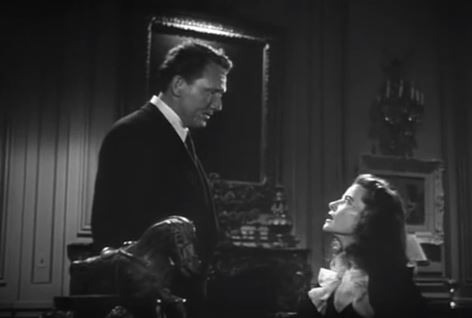

Kate unwillingly, as one sickened, relates to Tracy her realization in the early years of her marriage her discovery of her husband’s populist fascism. “They didn’t call it fascism.  They painted it red, white, and blue and called it Americanism.”

His supporters were private individuals who wanted power, but couldn’t get it democratically.  The campaign was a tapestry of hates. Hates for Jews, for city dwellers, for Catholics, for blacks, which appealed to the Ku Klux Klan.

“What was really shocking to me was the complete cyniscm of the plan. Each of the groups was simply to be used until its usefulness was exhausted.”  Again, as we mentioned earlier in this series, the cannibalistic nature of fascism that attacks its own.

“In the end, all the poor little people who never knew what the purpose they were lending themselves would be in the same chains.”

Tracy, coming to terms with the shock of this news about his hero, merely whispers his name, “Robert Forrester.”

Miss Hepburn adds, like a whimper, “He envied the dictators.”

Tracy whispers again, in horror, “Robert Forrester.”  His hero.

Hepburn’s further revulsion intimates a greater, more personal horror for her in her humiliating marriage, where she was, “A poor creature who couldn’t give him sons.” It’s a long speech, which she delivers delicately, with levels of awe and shame.

When she failed to warn her husband of the collapsed bridge, it was a moment’s decision. His paid saboteurs were waiting for his cue to being the plan of taking over the government. His chief lackey and henchman is his oily and conniving secretary, played by Richard Whorf, who is terrific in the role.


Also look for Percy Kilbride as a laconic cab driver, and Forrest Tucker as Kate’s ne’er do well cousin in an excellent supporting cast.

“Now he’s in your hands,” she tells Tracy.  The great man’s legacy, as well as the weakness of a great society to be exposed is a terrible crisis. She tried to keep his murder secret not to protect herself, but to protect the country from tumbling off into the ravine, too, in its blind devotion to a con artist.

Tracy counters, “People are not children. Sometimes they act like children when you get them scared or confused, but down in their hearts they know and they’re not afraid. They want the truth, and they can take it.”

It is a speech for the ages, and the hope on which I pin the outcome of the coming presidential election and the millions of Trump supporters who are apparently blind to his lack of integrity, his lack of intelligence, and the evil of the man.  Are they, too, lacking in integrity and intelligence?  Are they, too, evil?  I don’t know.  Like Hepburn, I, too, am horrified at the danger my country is in.  But like Tracy, I have hope in the basic decency of the American people, and I feel that courage is needed now more than ever to face the crisis.

Hollywood faced this issue unblinkingly with a fictional character. (We see another treatment in director Frank Capra’s Meet John Doe, covered previously here.) Movies today ignore the elephant in the room.

It ain’t over ‘til it’s over.  The evil henchmen step in to salvage the plan to takeover of the government, and Tracy and Hepburn are trapped by fire, shot at, and one is them is murdered.  The ending gives us a comforting bit of flag-waving as the bad guys are exposed and the country is safe now that it knows the truth.

But our country knows the truth, and yet it is not safe. There are too many who do not care about the truth.  Fascism is too appealing to them.

Hitler would have been right at home at the Republican National Convention. It would have been a bizarre, but strangely comforting, homecoming for him. Trump campaign signs hammered into American front lawns would have made him smile.

Come back next week when we wrap up this series with Burt Lancaster and Kirk Douglas in a frightening and fascinating treatment of a planned military coup in Seven Days in May (1964).


****************


My audio book version of Ann Blyth: Actress. Singer. Star., narrated by Toni Lewis, is now for sale on Audible.com, and on Amazon and iTunes.
 

Kamis, 04 Agustus 2016

Oh, my God, I’m home! You maniacs! You blew it up!


I recently saw Planet of the Apes (1968) on the big screen at the local cinema as part of the Fantom Events partnership with Turner Classic Movies. This has apparently been a popular series, with several releases every year for the past few years, bringing the novelty of classic film viewing back to the big screen.

This is part eight of our year-long monthly series on the current state of the classic film fan.

Though I regard a 1968 film as “too new” to be a classic, in this respect, I think I was not alone: the age demographic of the audience surprised me. I had expected a larger audience of young male sci-fi geeks. Instead, there were mostly middle-aged and senior citizens, I would say equally divided as to gender. Along with a younger couple that brought a few kids, the total audience numbered probably 25 people. 

It was a fun experience, and Ben Mankiewicz’s interview with “Dr. Zaius” before and after the movie made me laugh.  Except for the crack about Dr. Zira going to Smith College, which brought a few chuckles from the audience (Smith College is in my neck of the woods), I think I was the only one really laughing my head off through the whole thing. A rather dour mob. New Englanders. Probably brooding over the winter to come.

The other thing that surprised me was how the themes in this much-parodied pop culture movie-turned-“franchise” have remained relevant: the ape council’s rejection of science because it threatens the power of a fundamentalist government, the refusal to acknowledge truths that are not politically convenient, the cycle of prejudice and subjugation. Rod Serling wrote the script based on Pierre Boulle’s novel, and Serling's introspective and intellectual imprint is all over this movie.  There is a late 1960s feeling of the exhilaration of rebellion, without all the tired dystopian bilge we are beaten over the head with today.

When Charlton Heston comes upon the half-buried Statue of Liberty and screams his last lines, I’m sure all in the theater were quite familiar with the end of the movie, but there was still an awed silence, then the audience erupted in applause.  Though I enjoyed Mr. Mankiewicz’s and “Dr. Zaius’” vaudeville act at the end, it sort of wrenched one out of the really stunned moment at the end of the movie.  I think I would have preferred the TCM studio-filmed epilogue played straighter and not for laughs at this point, maybe an interview with someone connected with the production.

I have seen the other “apes” films, including the newer ones that are really nothing but CGI, lightweight and without the, forgive me, “human” feeling of the original series, and missing the theatricality of the original.  I can remember seeing one of them where computer animated characters bounced through a traffic jam of cars on a bridge, and the image was so irritating – like someone flicking something in your face to grab your attention – I closed my eyes. I like being able to explore the screen, drink in the image, and not have to flinch at constantly flashing images created by people who apparently have attention deficit syndrome and must think I do, too. 

I don’t.  Knock it off.

They are meant to appeal to a younger generation where video games are the main entertainment, and who apparently have a fondness for gray tones.  And revenge.

I wonder how many other people in the audience were regular viewers of TCM? Were any of them wondering who this guy was interviewing “Dr. Zaius”? Would the teen and twenty-something male sci-fi geeks whom I had expected to be there have any familiarity with TCM? Would they understand that I could enjoy the novelty of seeing a movie from my childhood nearly 50 years ago, on the big screen, and yet not call it a classic because it was too new?

How many of you have attended any of these Fantom Events series of classic films in your local cinemas? What did you think?

My local cinema is actually in another town.  My town once had some four or five second-run movie theaters, favorite haunts of three generations, small quaint palaces of enchantment, and all gone now.  We had a drive-in, too, once, but gone now.  I drive back across the river to my own town without any movie theaters.  (“Oh, my God, I’m home! You maniacs! You blew it up!”)

Just the word “Cineplex” depresses me.

Not that I mind watching classic films on TV; that’s where I first discovered them.  I think I’ve mentioned here before that when I was a very young child, I imagined what would be my perfect old movie watching experience: I would have a big cardboard box where there would be a screen inside on one wall, and a little low seat inside for me to sit and watch.  A door I could close.  I could press a button and watch any movie in the world I wanted.  There would be another button to push that would dispense any kind of candy.

I think I came up with this idea when that inevitable sadness overtook me after watching a movie to the end credits and knowing I might not ever see it again.

What strikes me is that I seem to have envisioned something like a VCR-function of this box to play movies at will; and that I apparently created what would be a solitary environment, though there were many movies (like the Three Stooges shorts) that I preferred to watch with my twin brother.  I could never have imagined watching them on a big screen with many other people in the audience, like in the old days.

The candy angle to my invention needs no explanation.

If you had your druthers, and could watch a classic film in any format, what would you like?  A subscription service where you could pick your choice out of hundreds of titles?  Watching on your computer, your iPad, your TV? Do you prefer Blu-ray, or DVD? Is large screen, or portability more important to you?

Would you attend classic film festivals if they were smaller, less expensive, and closer to your hometowns? What would you like to see programmed at these festivals?

Or would you just rather sit inside a cardboard box and watch Manhattan Melodrama (1934) in complete solitude, with any kind of candy you want?  Do youwant to do the programming?

Past posts in this series here:

Part 1 of the year-long series on the current state of the classic film buff is here: A Classic Film Manifesto. 

Part 2 is here: Cliff Aliperti’s new book on Helen Twelvetrees.

Part 3 is here: An interview with Kay Noske of Movie Star Makeover.

Part 4 is here: Evolution of the Classic Film Fan.

Part 5 is here: Gathering of the Clan at Classic Film Festivals.

Part 6 is here: John Greco’s new book of film criticism: Lessons in the Dark.

Part 7 is here: Tiffany Vazquez, new TCM host.

******************
Come back next week when we continue our series on the depiction of fascism in classic films with Keeper of the Flame (1942).

****************


My audio book version of Ann Blyth: Actress. Singer. Star., narrated by Toni Lewis, is now for sale on Audible.com, and on Amazon and iTunes.


Kamis, 28 Juli 2016

Storm Warning - 1951


Storm Warning(1951) is a bold slice of moody noir that is unabashedly a “message film” and is successful, however, by neither lecturing opponents, nor preaching to the choir, but by holding up a mirror and whispering, “Is this you?”

Ginger Rogers stars as a model who interrupts a sales trip for her company to detour to the sleepy southern town where her younger sister lives, for a long-delayed visit.  Her kid sister is played by Doris Day in her first dramatic role.  Steve Cochran plays Doris Day’s husband.  He is a truck driver; she works at the town’s entertainment center, which is really a glorified bowling alley that substitutes for nightlife in this town (Its owner, Ned Glass, is probably the nicest guy in the movie. A tougher job than you might think, considering his clientele.) She is expecting a baby.

Miss Rogers witnesses a murder. A group of Ku Klux Klan thugs drag a guy out of jail, beat him up, and then shoot him. Ronald Reagan plays the county prosecutor who investigates the murder. The movie is quite good, solid acting and moody cinematography, a fast-paced plot, that makes the film stylish and intriguing, and a bit creepy. That this movie has such entertainment value is important, because it is so obviously a message film. We have commented before on this blog that message films do not always appeal to the public, even when it is a message they need to hear. Nobody likes being preached to. The particular success of this movie is that though the audience is being lectured, they may be unaware of it, because it really is a good crime story – because the criminals are average Joe’s. Sometimes having an easily identifiable, sneering, Snidely Whiplash villain can be a bit tedious. We know where the plot is going. The bad guy is going to get his in the end.

But when the villain is pretty much everybody in town, and finding a bad guy to prosecute is like herding a bunch of cats, the story becomes more interesting because we don’t know who all the bad guys are, which ones of them are going to be brought to justice, and is there any justice at all?


One of the most common comments about this film is the complaint that the victim of the Ku Klux Klan murder is not a black man. He’s a white reporter.  There are very few African Americans in this movie. Many viewers feel that because of the prejudices of the day that the studio, Warner Bros., pulled a punch. That’s a valid complaint. Maybe they did.  It was certainly a big risk to offend the southern distribution market.  However, there is another way to look at this. I think in putting across the message, Warner Bros. did a sly, subtle, and intelligent maneuver by not making this film solely about racism.

Put a white robe and a white hood on a guy and we automatically identify the Ku Klux Klan with its brutality against blacks. We know that message. But some people, even those disgusted by this prejudice, may forget that blacks were not the only victims of the Ku Klux Klan. They also lynched, brutalized, and terrorized Roman Catholics, Jews, foreign-born individuals, and not a few journalists who were poking their noses in Klan business. The Ku Klux Klan are racist, but they are also fascists. Racism and fascism go hand-in-hand; you cannot have one without the other.

If Storm Warning does not particularly address racism against blacks, it does tackle the broader view of fascism, because the Klan in this town is made up of average nice people whose membership in this heinous organization they defend with a sense of self-righteousness. They feel they are above the law. When they are not terrorizing others, they threaten fellow members to stay in line. There must always be a constant threat, or there is no reason for having a Klan.  As we mentioned in last week’s post on Address Unknown, fascism is always cannibalistic.

This is our third entry in our series discussing how old Hollywood tackled the subject of fascism. We discussed The Mortal Storm (1941) here, and Address Unknown (1944) here.  Those two movies dealt with fascism and the rise of Hitler in Germany. Today we discuss native-born fascists. The Ku Klux Klan, not the only fascist hate group, but certainly the most well known, was born from the ashes of the Civil War, but the height of the clan really occurred during the 1920s, an era of great prosperity, and rose mainly in the Midwest, chiefly Indiana, the home state, coincidentally, of Republican vice presidential nominee Michael Pence.

Recently, a group of historians made their opposition to Donald Trump’s candidacy on social media.  One of them was 93-year-old William E. Leuchtenburg, whose The Perils of Prosperity 1914-1932 is a book I’ve long admired. He addresses the rise of the Klan in the 1920s among fundamentalist conservatives, the atrocities committed, and their astounding political power—until sexual and financial scandals drove them underground again.

At the recent Republican Party convention, congressman Steve King (R-Iowa) made headlines with his white supremacist remarks, and upon closer examination by the press, the so-called “Confederate” flag and the Tea Party’s (erroneously claimed) Gadsden flag on his desk.  

We know the old adage that politics makes strange bedfellows, and that even those who believe themselves to be virtuous will march in lockstep with people who are not, turning a blind eye to corruption, even evil, if it suits their purpose.

Donald Trump’s bullying rhetoric is asinine, his grandstanding is immature, unintelligent and without integrity, and so naturally appeals to those who are immature, unintelligent and without integrity, both in those politics and with the general public. There will always be some to whom his antics will appeal (including the television media, whose lust for ratings these days makes them the most shallow segment of the Fourth Estate).

Today’s film, Storm Warning, deals with fascism on its most lowest level, the small town, where the big men in town are not hidden, even if they wear a hood. Indeed, the funniest line of the movie is when Ronald Reagan approaches a Klan rally and sees a man completely covered by robe and hood and addresses him, “Hi, Ed. How are things at the dairy?”

None of these men are very powerful, and none of these men are very bright, and so we might not feel terribly threatened by them. But when they are all in a mob, they become a frightening spectacle indeed. It’s the particular sleight-of-hand of fascism. Whip people up into a frenzy, make them feel they are above the law, and then turn them loose. And then if they do wrong, whose fault is it? Who can we pinpoint to blame? It’s a wonder this country hasn’t suffered several slipped disks with all the shrugging we do.

Ginger Rogers suffers an obstacle course of horrors in this movie. She witnesses the murder while hiding in the shadows. It is a powerful scene as she stumbles away in the dark night, shaken, leans behind a lamppost and vomits. She finds her sister at work at the bowling alley and they go home together, and she tells her sister about the murder. Then her sister’s husband comes home.

Steve Cochran is an affable workingman, weak minded and easily influenced, and somewhat immature, who drinks a little too much and when he gets a little rowdy, is always astonished to find there are consequences to his behavior. He meets Ginger Rogers for the first time and welcomes his sister-in-law in a warm and friendly manner.

Ginger is frozen in horror at the sight of him. Steve Cochran was one of the mob who attacked the dead guy. We will find out later in the movie that it was Cochran, having had too much to drink, and getting excited at the mob frenzy, was the one who actually shot the guy.

Miss Rogers’ acting in this movie is quite good, understated, and believable.  She suffers the humiliation and the guilt of going on the stand at the inquest and lies about what she saw in order to protect Steve Cochran. She doesn’t like the guy, but Doris Day has begged her to keep his name out of it, and Ginger would do anything for her sister. Later, when she gets him off, Steve will get very brave, and very drunk, and spy on Ginger when she is changing her clothes and packing to leave. He catches her in her slip and makes overtures. Instead of shrinking away from him, Ginger stands right up to him, does not even pretend to cover herself, and lets him have a good long look while she tells him to his face that he is a “stupid, vicious ape.”


Then he attempts to rape her, but Doris comes home in time, pulling him off Ginger. Doris finally comes to the realization that her husband is really not such a nice guy, and she is ready to leave him. Now Ginger is free to go to the authorities and tell them what she saw. Cochran, panicked, punches Ginger and drags her to a Klan meeting to suffer their punishment.

I like Cochran's work in this movie, he is charming and exasperating, and scary at the same time.  We last saw him play a very different villain here in Slander (1957), where is character was more cool and intellectual.  He was a handsome actor, with a good solid range.


I also like Ronald Reagan’s acting in this movie. It is low key and understated. With his Fedora pushed back off his head and his low, quiet voice, he represents a decent man of authority in town. He is not an outsider, he grew up here. He is not so much a shocked crusader of human rights, just a guy who knows this town inside out and is sick of its imperfections. He’s tired and disgusted. But he plods along trying to do his best, persevering, and hoping one day to catch enough evidence on the Klan to put somebody in jail.  So far, he has been unsuccessful.  He is not an idealist, but a pragmatist, knowing nobody’s going to have a very good life in this burg if everybody’s a slave to a bunch of rowdies.

As regards another complaint about this movie and it’s skirting of the racial injustices in the South at this time period of the early 1950s, no one in this movie speaks with any regional southern accent. This time around, I don’t feel that that is typical Hollywood sloppiness. I really sense that this was a subtle and quite intentional move to bring the subject to a level where it applies to everybody. Though the Klan was a product of, and continues to be, a blot on the South, it is also possible to discuss racism as it applies to everyone in this country without pinpointing a particular group of people. Sometimes when we pinpoint one segment of our society of being guilty it is very easy for us to wash our hands of the guilt. We say, oh, that’s thosepeople. We would never behave that way ourselves.

But fascism is a template that fits anywhere. In today’s political climate there is a great resentment, and perhaps always has been, of “Washington.” Ronald Reagan complains to the boys at the police station, “Every time someone from New York or Washington pokes his nose into our affairs, we holler, ‘Foul!’ Well, if we don’t want them meddling, one of these days we’re going to have to start cleaning up our own nests.”  He is calm, world-weary, and his quiet voice tells us he is sick of the lynchings and sick of trying to tell his best friends and neighbors what is so obvious: stop dividing the world into us and them. That is where fascism has its roots.  There is an inherent thuggishness in an "us" and "them" attitude.

The minor characters show the warts and make his point for us. The bus station baggage claim guy played by Paul E Burns, is afraid to stand up to the Klan.  It sickens him, and sobbing, he begs Ronald Reagan not to question him because he’s afraid they will burn him out.  He regrets being a coward. Later some of the boys will rough him up teasingly, and Ginger Rogers will come to his rescue.

Even the Klan’s leader shows his contempt for his own men. “You know these boys. Without those hoods, they are no heroes. That’s why they need the hoods in the first place.”

The scene with the reporter arriving to do man-on-the-street interviews at the enormous crowd in front of the courthouse is quite good. It looks real, not stagy, as the reporter struggles to pull his microphone cable through the crowd, and he makes comments and ask questions and the people either pipe up or else tell him to get lost. This is the only scene where we see a few African Americans in the crowd. I think it is used intelligently. They show us quite visibly that this is a topic that includes them. Almost as if to say, yes, the murdered guy was white, and we haven’t mentioned racial prejudice here, but you know we really are talking about that, don’t you? You know what this is really about, don’t you?

In case we missed it, the local Klan boss played by Hugh Sanders puts it bluntly in his defense of the Klan to Ginger Rogers, “You have to think of all the good the Klan does. Without us, a girl like you wouldn’t be safe in the streets at night.”

Safe from whom?  We know to whom he’s referring. If he had bluntly said or referred to in the most vulgar vernacular, that she was in danger of being raped by black men, it would have been a different movie. Yes, it would have been bolder, but it also would have switched the focus for people who automatically turn that message often their minds because it offends them, because they do not wish to face their own prejudice, or else because they feel their own prejudice is justified. By talking about racism as fascism and applying it to everybody as a principle that is evil and a danger to everybody, we reach more people because the audience cannot say, oh, you’re talking about them, you are not talking about me. Because I am not like that.

Yes, we’re talking about you.

By the way, I love the reporter’s Ted Baxter voice. Why do not radio and television reporters speak like that anymore?

We are also talking about Ginger Rogers. She is a girl of integrity, street smart, and even though she is a high-tone fashion model, we know she is not upper crust, not removed from the realities of the day. When the ad man accompanying her on the trip makes passes at her at the beginning of the movie, she sends him off like an expert fencer and shoves him on his way. This gal is a tough dame. She is no pushover.


But she rolls over and plays dead for the Klan and lies to Ronald Reagan in front of everybody, because she thinks that protecting her sister’s husband will get her sister out of a jam. It is like putting a Band-Aid on a severed artery. She just wants to smooth things over and leave town as quickly as possible. In such innocent ways do we become complicit with corruption.

A nice touch when, trying to squeeze out of the close crowd at the end of the trial, she and the dead man's widow are pushed together, face-to-face, and Ginger squirms under the woman's accusing stare.

When she leaves the courthouse, Ronald Reagan, frustrated in defeat, tells her off and actually shoves her out the door, “Now, beat it.” He tells her over the sound of the jubilant men outside whooping and hollering because they have won and nobody’s going to go to jail, “They just found out the law cannot touch them. You did that.”

It’s a powerful ending with two scathing realities: first, Reagan tells the Klansman at the rally, a huge burning cross above them lighting up the black sky, “It’ll take more than these sheets you’re wearing to hide the fact that you’re mean, frightened little people, or you wouldn’t be here desecrating the Cross.”

They are mean, and they are frightened and they’re letting their fears make them mean.

They kidnap Ginger Rogers, but things are too hot for them right now to just kill her outright. Instead, they will punish her with whipping.  The scene could easily be gratuitous—most movie whipping scenes tend to go for eroticism, to varying degrees, certainly when the victim is female. Instead, they slash her in the face with the bullwhip, repeatedly, to scar her.  We don’t see any marks on her – the magic of Hollywood—but the image of her being hurt in this manner does not stray into eroticism and therefore seems more profoundly cruel.

But the Klan in the 1920s, as Dr. Leuchtenburg points out, had a particular fondness for stripping naked “fallen” women – according to their standards (which included divorcees) – and whipping them.  Filming such a scene would have been truthful, but impossible to film without it being also gratuitous.

I have to applaud Warner Bros. for the courage of the second reality: to just let the movie end in tragedy with no happy ending, no, “Maybe we were wrong and things will be better now,” and no romantic clinch between Reagan and Ginger Rogers.  There is no flirtation between them; indeed, as mentioned above, he gives her a shove in disgust.  He’s arrived in the nick of time like the cavalry to save her, but he’s not her boyfriend.  The only clinch at the end is when Ginger Rogers cradles the dying Doris Day in her arms.  Day has been shot, accidentally, by her husband who was aiming for Rogers.  The end.  Go home and chew on that for a while.

Fascism is always racist, opportunist, and corrupt, and it poisons every level of society. 

But it doesn’t start there.  “Populist” movements have a big hand in keeping fascists in power, but they don’t have the clout to put them there. That takes money.  All the dictators of the world had their backers, wealthy men holding the purse strings, powerful men in the military, some to drive the vote to their best interests, and some to grab public office for themselves.  This will be the case in our last two movies: Keeper of the Flame (1942), and Seven Days in May (1964), which we’ll discuss in August.

Next Thursday, however, a break with a return to our monthly state of the classic film fan series. See you then.

*****************


My audio book version of Ann Blyth: Actress. Singer. Star., narrated by Toni Lewis, is now for sale on Audible.com, and on Amazon and iTunes.


Kamis, 21 Juli 2016

Address Unknown - 1944


Address Unknown(1944) is a very artistic examination of the consequences of fascism. The cinematography creates an otherworldly palette of light and shadow, of angles, of unbalanced screen images that is poetic and visionary. Classic films took on the subject of fascism and planted the nightmare on an everyday familiar world with everyday people we could relate to, unlike modern films which might tackle the grand subject of good versus evil and place it in an imaginary futuristic or superhero setting. The characters in classic films were unable to escape their circumstances with special powers or an arsenal of apocalyptic weaponry. They had only their brains, their courage, and their conscience.

This the second film in our series on classic films’ depiction of fascism. We covered The Mortal Storm (1940) last week here.With Donald Trump’s Faustian rise to become the official Republican Party nominee for President this past week, the subject of fascism is one we need to examine very closely, not as a history lesson per se, viewed safely from a distance, but as a very personal blueprint on how to fight it in our midst—with brains, courage, and conscience.

Address Unknowncame late in the war, and so was not so much a warning of the consequences of what was going on in Nazi Germany – though certainly, Hollywood likely felt the subject still worth pursuing morally and financially. The interesting thing about the movie is it shows very little of jackbooted Nazis, the sneering villains of most wartime patriotic fare. It is instead a psychological nightmare of one man’s seduction, and the price he pays for going over to the dark side. As such, it is not a flag-waving, drum-beating story, but a mature, contemplative tale that, unfortunately as we see today, is timeless.

Paul Lukas stars as a German-born art dealer who has lived in San Francisco for many years. He is married to Mady Christians, and they have five sons. Four of the boys are school-age, the oldest, played by Peter van Eyck, is a young man and works in the art gallery with his father.

Morris Carnovsky plays his longtime partner in the gallery, also originally from Germany. Mr. Carnovsky is a widower with a grown daughter played by K.T. Stevens. Stevens, and Mr. Van Eyck, have known each other since childhood, are romantically involved and intend to be married.

The story begins with the partners toasting each other on a sunny terrace in San Francisco, grateful for their life in America, and secretly celebrating because they think that Lukas’ son and Carnovsky’s daughter are about to name the day of their wedding. These old friends look forward to having their families united. It is also something of a farewell celebration, because Paul Lukas is slated to take his family back to Germany for a period of time to do business for their art gallery. Lukas will buy paintings in Europe and ship them back to Carnovsky in San Francisco to be sold in their gallery. Paul Lukas’ eldest son, Van Eyck, is going to remain in America to work at the family business. However, Carnovsky’s daughter, Miss Stevens, is going to go to Europe with Paul Lukas his family to study acting.

The fathers are disappointed when the young people announce that they are not going to set a date for their wedding. They are going to wait until Stevens returns from Europe and then decide on their plans. It is a great letdown, and the mood of the story changes with this first announcement.

In Europe, Paul Lukas will meet Carl Esmond, a local baron who will seduce Lukas with the lure of the brand-new Chancellor Adolf Hitler.  Mr. Esmond is educated, erudite, and hardly a Nazi thug. But he approves of the order and discipline that Hitler is bringing to Germany, the pride Hitler appears to be instilling in young people, and even though Esmond is a nobleman, the kind of person Hitler hated, he takes the view that Germany is progressing for the good. He will make Germany great again. We last saw Carl Esmond as they bad guy bullying Ann Blyth into a forced marriage in The World in His Arms (1952), and here as the Nazi officer in Resisting Enemy Interrogation (1944).

Mady Christians, whose film career was winding down (she died in 1951) was reunited with Paul Lukas in this picture. You may recall we mentioned her as playing opposite Lukas on Broadway in Watch on the Rhine in the same role that Bette Davis took in the 1943 movie of that play. We briefly mentioned it in the intro to the Ann Blyth series, but a more in-depth look at that play can be found in my book, Ann Blyth: Actress. Singer. Star.


Mady Christians, like Mr. Esmond, originally hailed from Vienna, and there are a number of German cinema actors in this movie to give it credence. There are also a few old Hollywood character actors who are fun to pick out, including Amory Parnell as a busybody mailman – who has a much more important role in this movie that we might realize later – and Frank Faylen plays a smart alec journalist.

Paul Lukas, just on the strength of his performance in the film Watch on the Rhine, for which he won an Oscar®, is one of my favorite actors. Address Unknown really shows his range, particularly when you compare it to the hero he played in Watch on the Rhine. That film showed a man courageous, committed, but deeply torn by his commitment and what his actions were doing to his family in his effort to fight fascism. He declares what he does for a living, “I am an antifascist.”

In Address Unknown, he plays a man who falls under the spell of fascism, which leads to his own doom. His work here is meticulous and we can always see the range of emotions playing on his very expressive face. His joy at the thought of his son marrying his partner’s daughter; his disappointment when they hear the marriage is to be delayed; his amused, eye-rolling attitude over his young sons, who, all born in the United States, are going to run into culture shock when they go to Germany with him because there will be no baseball there. He is a proud and indulgent father, an attentive and kind husband, and a loyal and affectionate friend to his partner. He is a good man. Because he is a good man, he seduction into the Nazi creed is all the more painful for us to watch. It is easy for us to dismiss bad guys and morons as bad guys and morons, but when we come across a gentle soul who turns evil and is corrupted either because of a lack of will, or a desperate need to be flattered, we are faced with an even stronger message of right and wrong.

That is the particular achievement of this movie. It does not serve up platitudes, and it does not show things in black and white, but there are still clear demarcations between right and wrong, and like people walking on a footpath in the woods, following a marked trail, if we keep our eyes open we can see them, clearly. If we are careless and do not pay attention, we turn the wrong way and get lost.

How this tale is told in this introspective and intelligent examination is largely through stylistic imagery. The director here is William Cameron Menzies, and the film has a wonderful mosaic of extreme close-ups, off centered positioning of the subject, and stark lighting. We begin the movie with extreme close-ups of Paul Lukas and Morris Carnovsky toasting each other, and it almost looks like a scene out of Citizen Kane (1941) and a similar kind of cinematography here. The movie is quite visually stunning, and it turns this simple story to one of deep psychological horror.

When Paul Lukas and his family get settled in Munich, he receives a letter from his partner Carnovsky in San Francisco. Lukas is delighted to receive the letter because already he is homesick for America. 

Carnovsky asks, “Who is this Adolf Hitler?... I do not like what I hear of it.”

This movie is about an exchange of letters. It is based on a novel of the same name where the plot is told through the exchange of letters between these two men.

Paul Lukas can hardly answer Carnovsky, because he is still new to Germany, does not really know much about Hitler himself, but almost immediately his ability to reply to this question is stifled by Carl Esmond. Esmond encounters Paul Lukas and a friend in a local ratskeller that Lukas knew from days gone by. Lukas looks around; it is quiet and forbidding and he says the place has changed from the happy place he knew as a youth, but he can’t put his finger on it. He has read the letter aloud, and Esmond, with cool authority, tells him about Hitler’s virtues.  We see Lukas’ expression turn from curiosity, to being flattered that the great Baron is sharing a table and sharing his knowledge and giving him attention, but Lukas is embarrassed that his friend in America has asked this question and put him in an awkward position when he has read it aloud.

Carnovsky in San Francisco gets a letter from Lukas telling him that Hitler is good. Oh yes, he’s done some bad things, storm troopers breaking windows and being thugs, but essentially we have to take the good with the bad. Carnovsky and Lukas’ son, Van Eyck are surprised to get such a letter. Van Eyck immediately expresses concern about Miss Stevens.

We are back in Vienna when Miss Stevens shows up at “Uncle” Paul Lukas’ house in Munich. She enters at the end of a long shadow. She warmly greets him and he is pleased that she has come. She has taken the stage name of Stone because it is shorter and will look good on a marquee. The Baron is there when she visits and he notices that her monogram on a purse does not match her last name of Stone. When she has left the room to visit with her “Aunt” Mady Christians, the Baron asks Paul Lukas about the monogram, and Lukas gushes that Stone is just a stage name, that her real name is Eisenstein.

The Baron says the one word that puts fear into the heart of Paul Lukas. He asks, “Jewish?”

For the first time, we realize that Morris Carnovsky and his family are Jews. This is not a fact that has ever distressed Paul Lukas in the past, but suddenly it changes things. We see the expression on Lukas’ face. He is uncomfortable, he is embarrassed. The Baron warns him about such an association and leaves. The camera settles on Lukas for a moment, again his face registering a changing parade of emotions. He is like a child who is fretting, pouting and resentful that his party has been spoiled. There is a shot about table height looking up at Lukas and his grim expression tells us he has reached a decision. He turns off the table lamp. We are left in darkness by his hand.

In San Francisco, Carnovsky gets a letter, “We must, for the present, discontinue writing each other. You will understand, I know, that it is impossible for me to be in correspondence with one of your race.”

Van Eyck reads the letter over “Uncle” Morris Carnovsky’s shoulder. “What in the world is he talking about? He must be insane.”

Carnovsky is more forgiving. He understands that Lukas is only writing this letter because of the censorship that is going on in Germany at the moment. He must say the right thing or he will get into trouble. Carnovsky is hurt, but he understands. But he brightens, he tells his partner’s son that there is another way that they can freely send letters and not have to worry about the censors. He will send a letter to Lukas hand-carried by a friend who is an American journalist.

Our old friend Frank Faylen is the wiseguy journalist, who sits in the office of a Nazi bureaucrat, where Paul Lukas works at a new job – he has apparently given up being an art dealer. Faylen is unimpressed by the officious Nazi gatekeepers and lower-level management of this government office, and bluffs his way in to see Paul Lukas. You may remember Faylen most from his role as Ernie the cabdriver in It’s a Wonderful Life (1946). He cheerfully gives Lukas the letter, but Lukas dismisses him arrogantly.

Back in San Francisco, Carnovsky, now desperate to clear the air and understand Lukas’ intention, writes one more time saying that he understands there is censorship, but that he needs some word of reassurance from Lukas that everything is all right in their friendship. “But there is so much madness in the world, I need a word of reassurance.” The simple word he requests Lukas to send back is “yes.”

Lukas’ answer is no.

Van Eyck has had enough. He wants K.T. Stevens to come home now. Her father reminds him that she’s up for new job in Berlin as a leading lady and he doesn’t want to cable her and spoil her big night. They will wait to contact her.

We go to Berlin, where her play is being rehearsed.  It is a religious theme and she is to recite the words from the Beatitudes, Christ’s words from the Gospel of Matthew. During rehearsal a Nazi official tells the director the following lines are censored:

Blessed are the meek, for they shall inherit the earth.

Blessed are the peacemakers, for they shall be called the children of God…

…and other lines from the Beatitudes. Disobedience is treason.

On opening night, the feisty Miss Stevens decides to say the forbidden lines. The censor stops the show and demands the director to come out but Stevens courageously defends the director saying that she was the one who made the decision to put those lines back in.

The smarmy little censor announces to the audience that the actress’ name is not Stone, but rather Eisenstein. In a moment we hear murmurs in the audience, and soon shouting, of the word, “Juden!”

Stevens, who was brought up in America, not only finds this all a bit too ridiculous to swallow, but she is proud of her heritage and will not back down. It ends in a mob scene, in a chase and she is on the run.

Eventually, a hunted outlaw, she will make her way to Munich and her “Uncle” Paul Lukas’ home. Brownshirts are fast on her heels. When he answers the door and sees it is her, he will not let her in. She has been hurt and she’s bleeding from her hand, and she leaves a bloody handprint on his wall as he closes her out.  She’s shot on his doorstep.

Carnovsky gets a curt letter in San Francisco, “Heil Hitler. Your daughter is dead.”

Carnovsky sits, sobbing, utterly destroyed, while Van Eyck gently pats his shoulder. We see a close-up of Van Eyck’s hand in ministering comfort and then pulling back, forming into a fist. A subtle symbol that’s important later.


Back in Germany, Mady Christians has just had another baby, another son. At the christening, Baron Carl Esmond congratulates her on having so many sons, thereby doing her duty. The parents smile to their guests, but when they are alone with the baby, we see their marriage is on the rocks. Mady Christians is disgusted with Paul Lukas. She dislikes the change in him, and she is horrified at his having turned away Stevens in her hour of need. She intends, when the baby is able to travel, that she will take her sons away to Switzerland.

Things have definitely turned sour for Paul Lukas. He starts receiving more letters and cables from San Francisco, but he doesn’t understand the messages. They mention painters and artwork but the notes seem to be written in a kind of code. He can’t make sense of them. We see that the censors picking up on this code are starting to make things a bit hot for Paul Lukas. He is being watched. The Baron questions Lukas’ loyalty to Germany. Lukas is helpless and floundering. He tries to defend himself. He tries to write back and pleads with Carnovsky to please stop writing him because he’s in terrible trouble. Every letter he gets puts him deeper and deeper under suspicion.

We have seen throughout the course of this movie the great psychosis that is fascism. He is seduced by falseness, by flattery, by a sense of power, by being told he is better than other people, but it is a double-edged sword. By propping up a fascist government, one very easily – and over very little provocation, almost in the blink of an eye – can become its victim. Fascism is invariably cannibalistic. Lukas has become terrified. He has become paranoid. He is now an enemy of the state he once was so proud to join. It is difficult to walk that line. This is why inevitably fascist governments fall, but of course, not until they do great damage on a civilization.

Lukas writes to his son instead and begs him to stop Carnovsky from sending any more messages. He writes, “You must go to any lengths, as you are my son.”

It’s an interesting line. We imagine perhaps Lukas means that Van Eyck should kill Carnovsky. As you are my son.  Fascism demands ultimate loyalty.

The Baron is convinced that Lukas is a spy. When he confronts Lukas, the mail comes again and Lukas is nearly sick with worry when a letter arrives from San Francisco. He really isn’t doing anything wrong, obviously. He is not a spy. He has been a loyal member of the Nazi party and done everything they asked him to do. He wanted the prestige they gave him. He wants to be a good citizen of the Third Reich. But they don’t believe him. His intentions are irrelevant. He is under suspicion. To be under suspicion is to be automatically guilty. There is no due process here. To be slow to answer is to be guilty.

Mady Christians takes their children and leaves for Switzerland. Lukas gives her a letter to send to Carnovsky, begging him to stop sending any more letters. She is stopped at the border, but she is allowed to pass because she is no threat to the Third Reich. The Baron comes to warn Lukas for the last time, and Lukas, in desperation tells him that the letter his wife brought to Switzerland is the proof that he never wanted Carnovsky to write to him. He is told that ironically the letter was confiscated and destroyed. He has no proof.

We end this interesting movie with two grim scenes. Lukas stands outside the door of his home, an expression of deep horror etched on his face at approaching thugs coming to get him. He will be going to a concentration camp. Or murdered.

Then we go to San Francisco where Carnovsky reads a letter from Lukas that has been returned to him marked “address unknown” on the envelope. He is puzzled. Van Eyck is standing near him, watching him.

Spoiler time. The whole post has been a spoiler, but sometimes to be blunt is more necessary than to tease. 

Carnovsky tells Van Eyck that he hasn’t written to Lukas in months, that he didn’t write this letter to him. He stopped when Lukas originally asked him to send no more letters.

We see Van Eyck’s face. He wrote the letters. He wrote them to implicate his father and to purposely put his father in danger. He wants revenge over the death of his fiancĂ©e. He wants to kill the monster that the Nazis created.

It’s a cautionary tale of sorts—beware the company you keep—but so artistically framed that we are not bludgeoned with lessons and morals. The lessons and morals are obvious.

Unless one is the kind of person to whom lessons and morals are not obvious, and they are the real perpetrators of fascism, not the ones in power, but ones keeping them there.  And they are, ultimately, its victims as well. Eventually.  But some weak-willed, weak-minded souls are only too happy to vote against their own best interests.

When you deny rights to others, you’re next.

Come back next week when we take on Storm Warning with Ginger Rogers, Ronald Reagan, and Doris Day. Part 8 of our series on the current state of the classic film fan follows the first Thursday in August. Our look at fascism in classic films will continue with two more movies in August, where we bring the curse to America.

*********************


My audio book version of Ann Blyth: Actress. Singer. Star., narrated by Toni Lewis, is now for sale on Audible.com, and on Amazon and iTunes.